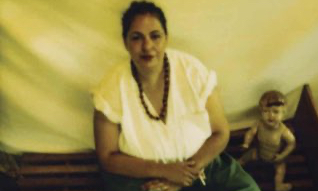
Her urban pilgrimage from Port Melbourne housing commission confinement to an exclusive education at ‘Mac Rob’ and Melbourne Uni and then landing the dream job of working with Charlie Perkins, famous Aboriginal activist and later to be honoured by a retrospective exhibition at the Ian Potter NGV Gallery , for her major role in the Australian Arts. Intelligence, wit and a ‘way of seeing’, enabled Destiny Deacon social mobility and success.
In writing is reads like a Cinderella tale, and yet the ugly sisters racism and sexism left their mark on her perception of self and fuelled her political and artistic roles. Born into a large family with both parents engaged in Aboriginal rights, would have bred a restless spirit in Destiny. Able to throw off the shackles of the housing commission stigma and pass the entrance exam of Mac Robertson high school, would open doors for her future academic role at Melbourne University.
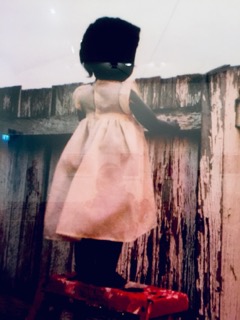
OVER THE FENCE 2000
Despite her intellectual achievements Deacon would be ‘looking over the fence’, not fully assimilated. She had access to the very best of what ‘white society’ offered, but being ‘Blak’, she also shared the inner trauma of a ‘mob’, a community that had been denied, deprived, daunted and desecrated. Working with Charle Perkins would have sharpened her political position, it also introduced her to Perkins daughter Hetti, a NSW Art Gallery Curator. Destiny and Hetti would form a friendship and a working relationship where Deacon was represented by the NSW Gallery collection.
ADOPTION 2000
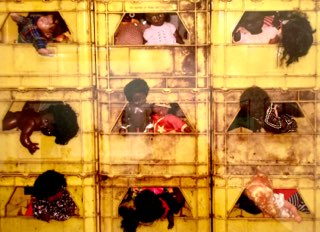
Her art work is thoughtful and provocative, she coined the term ‘Blak’ and used doll avatars to carry her observations and statements. The dolls are a profound choice, to illustrate the innocence and manipulation of Aboriginal communities and their children. Her work strikes the core nerve of the ‘stolen children’ cruelty, where the emotional damage was ignored, as they were treated as pawns.
The Darwinian experiment of taking children to make them white, was sparked by Darwins visit to Australia in 1836. His theories led to social prejudice, with terms such as ‘primitive’ being used to create a social divide that carved Aboriginal policy. The evolution fantasy, perverted the perception of Aboriginal people to the point that they were regarded as ‘fauna’.
BORDER PATROL 2006
Deacon found her niche in Koorie Kitch and Australiana, as a form of story telling. The exhibition at the NGV Ian Potter Gallery honours her life and her story as an International Artist raised in the streets of Melbourne.
“Why were there so many good women artists working in Australia in the 1920’s and 30s, involved more with inventive, rather than imitative art?”
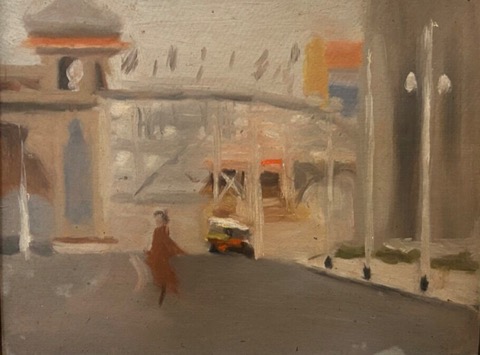
Wet Evening 1927 C Beckett
(Australian Art A History, Sasha Grishin, p219)
It takes a Melbourian to spot another; we feel comfortable with each other, despairing under the heavy grey roof of clouds, moody and cold; sharing the melancholy, the dullness and the empty vacuum of being alone within a cultural and landscape scene, of exciting monotony. Becketts urban scenes may have been painted 100 years ago, but the tone remains the same. We recognise ‘those days’ and ‘those streets’; the sound of wet rain on the road.
Beckett studied under Australian Master Artist, Fredrick McCubbin (1855-1917) in 1914, at the NGV art school when it was housed in the State Library. McCubbin is renown for his idealistic bush scenes of muted realism, although known as an Impressionist, his scenes were uniquely his own interpretation. He didn’t travel to Europe until later in his life and his art grew within the Heilderberg scene. He had studied under Eugene Von Guerard, and was influenced by his romantic storytelling, that made McCubbin a household name.
Shelling Peas 1913 F McCubbin
When Beckett studied under the older artist, he had returned from Europe and had launched into his lesser known period, where detail was abandoned for a blunter European Impressionism. McCubbin’s new focus was less colonial and more urban and this would have enabled Beckett a more local focus for her themes.
Walking Home 1931 C Beckett
Beckett however broke away from the safe confines of her masters instruction and into the edgy new scene of modern Tonists that was led by McCubbin’s rival Max Meldrum (1875-1955), known as an ‘art upstart’. Beckett was Meldrum’s star pupil and member of the exclusive Twenty Melbourne Painters Society, that broke away from the Victorian Art Society, which is an art society limited to 20, that still runs today.
October morning 1927 C Beckett
“Meldrum was in many respects an outsider, rather than an accepted member of the art establishment”
(Australian Art A History, Sasha Grishin)
Meldrum taught his students to use limited palettes, hazy outlines and attention to the breakdown of tones. He regarded he’s study of tone to be scientific and aimed to create compositions that explored light, atmosphere, space and distance. Simplified forms and how they contrasted tensions, created a structure of order, when the artist approached their canvas.
Wet day Brighton 1928 C Beckett
Melbourne’s moody skys and the strong contrast of seasons is the perfect homeland for an artist who lived and focused her work on the eastern bayside villages. Beckett’s work never received the fame she deserved in her lifetime and although she was a prolific artist, most of her work was destroyed in poor storage. A longer life may have solved the issue but harsh Melbourne winters took their toll, on a woman, her trolley and the outdoors.
Princes Bridge, Flinders Street Station and clock tower 1930 C Beckett
This typical Melbourne scene has never been captured so well, a mood many morning commuters are familiar with. Her work evokes an emotional response like a shared memory of an event. She takes us on a urban tour through her art. Her work stikes a deeply personal tone within the viewer, it’s not a story, it’s home.
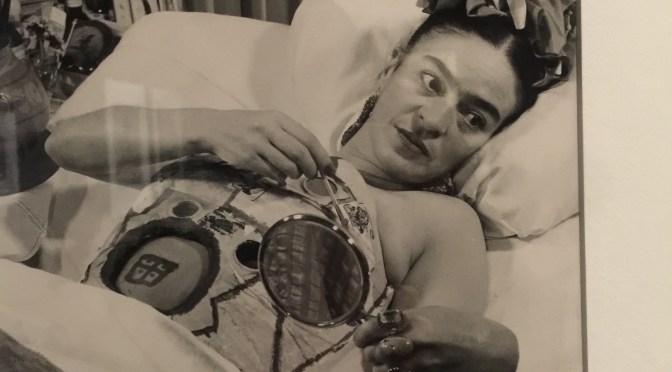
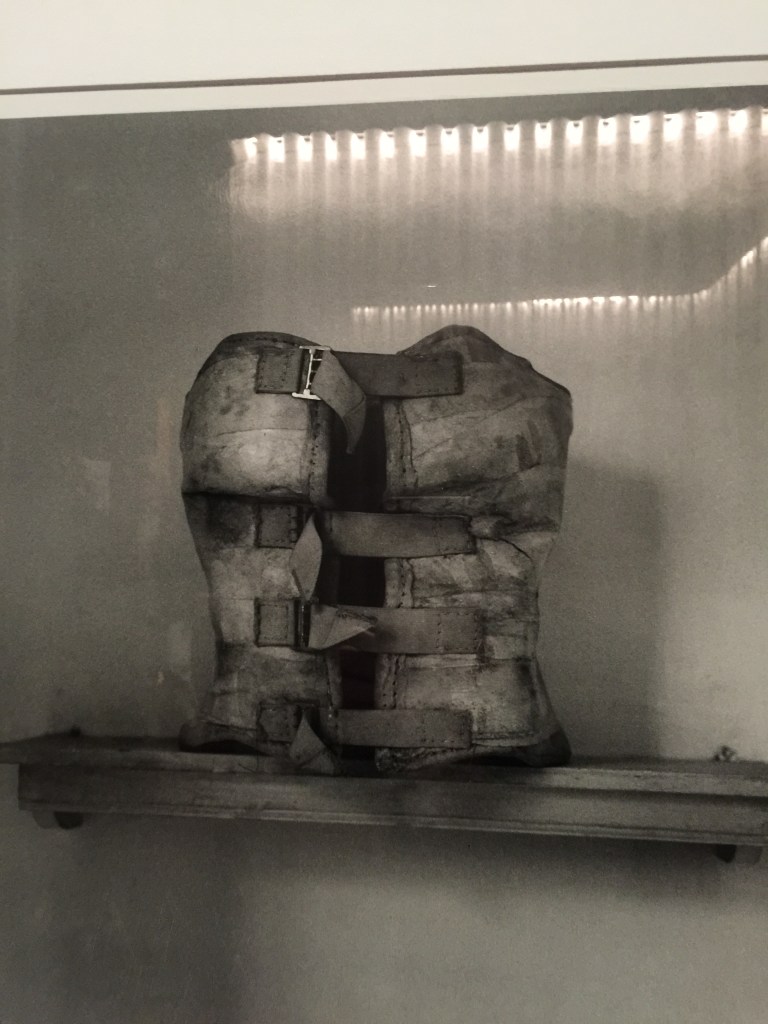
Frida Kahlo was shackled in a body, and rooted to an artist, that life had chosen for her. She may have aspired to be a doctor, and marry a young man, to have a car load of children; but this was not for her.
“There have been two great accidents my life, one was the trolly, and the other was Diego.”
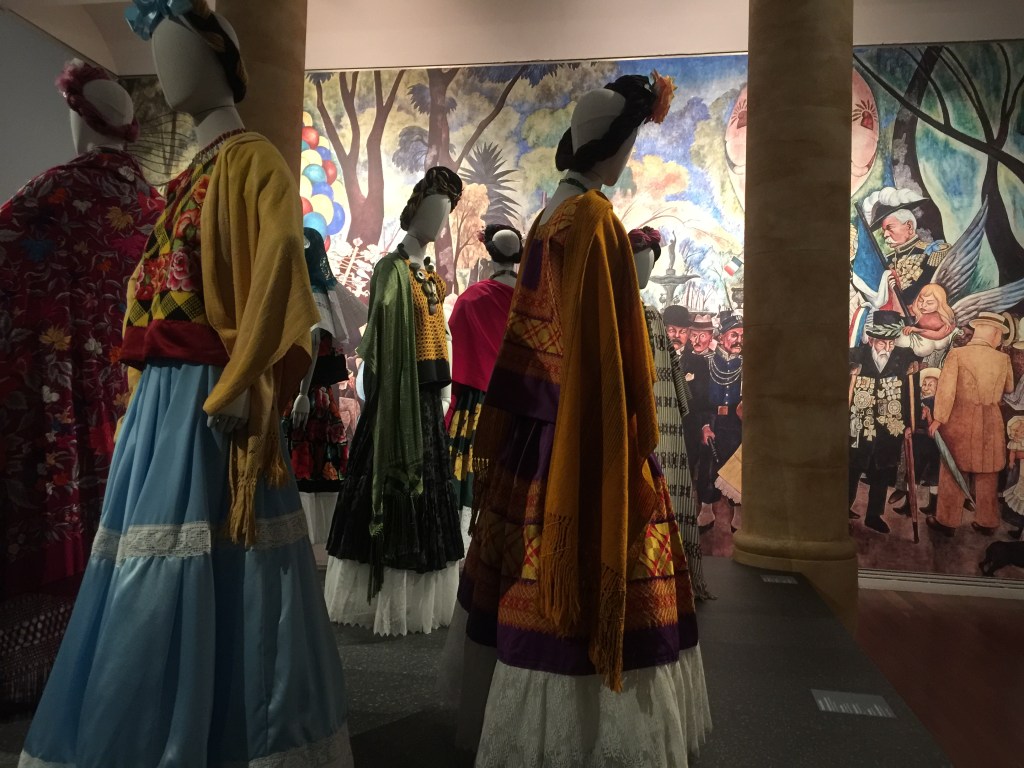
Her flowing garments distracted the viewer of the restrictions within.
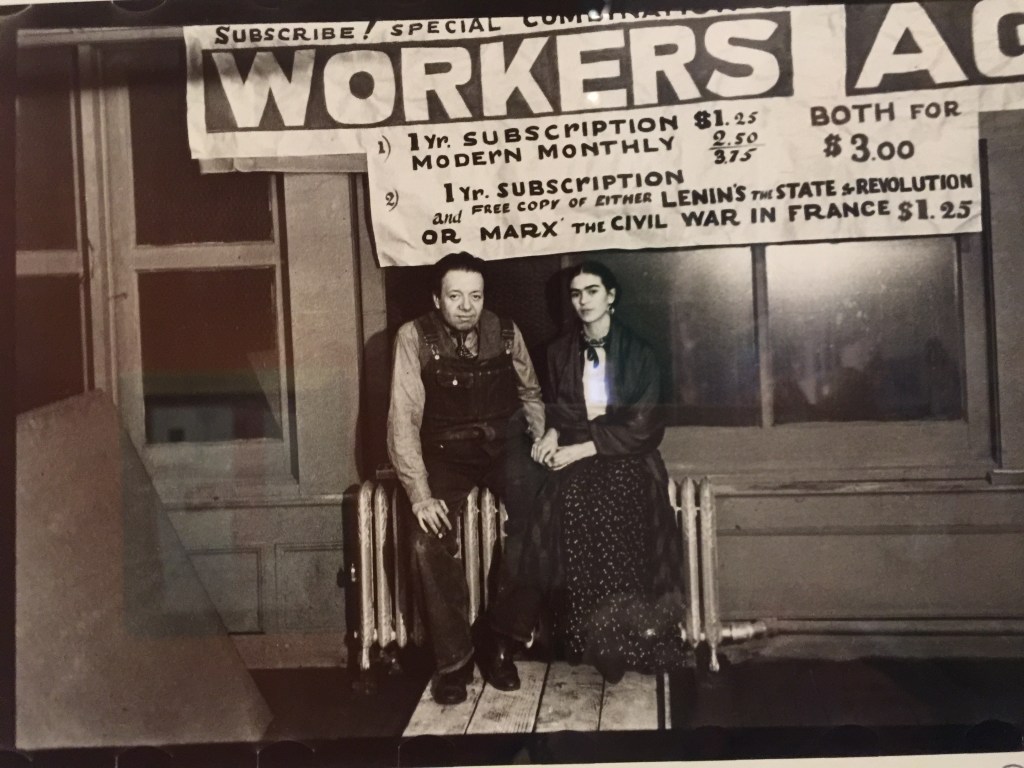
The exhibition celebrates the marriage of a Mexican couple that played definitive roles in the Modern Art movement, that of Frida Kahlo and Diego Rivera. Rivera was an artist employed by the communist party to promote the working class and Kahlo became an icon for the feminist movements.
Their marriage was not a happy one due to Diego’ affairs and Frida’s health issues. They divorced after Diego slept with Frida’s sister and reunited after many years of difficulty.
Within the deep loneliness of betrayal, she made a friend of self portrayal, documenting her stoic response to a body was held together, and coming apart, like her marriage; she was on shaky ground. The unsmiling cool demure, and films of Diego shuffling around her like a creative volcano, that was ready to explode, depict the tension.
Despite Frida bravado and staunch feminist tendencies, she was vulnerable to the whims of her husband. Somewhere within this mistress of disguise, was a frail heart, that revolved around her Rivera.
Diago on my Mind 1943 KAHLO
Diego, an accomplished artist, was 20 years her senior, who studied fresco painting in Italy and a was a Mexican art star. As a communist he was interested in the condition of the worker.
Fresco wall art 1932
In his portraits and paintings, we see the ‘lover of persons’, that Frida would have basked in. His sensitive attention to the the subject and ‘eye’ for subtle beauty is enriched in his depictions.
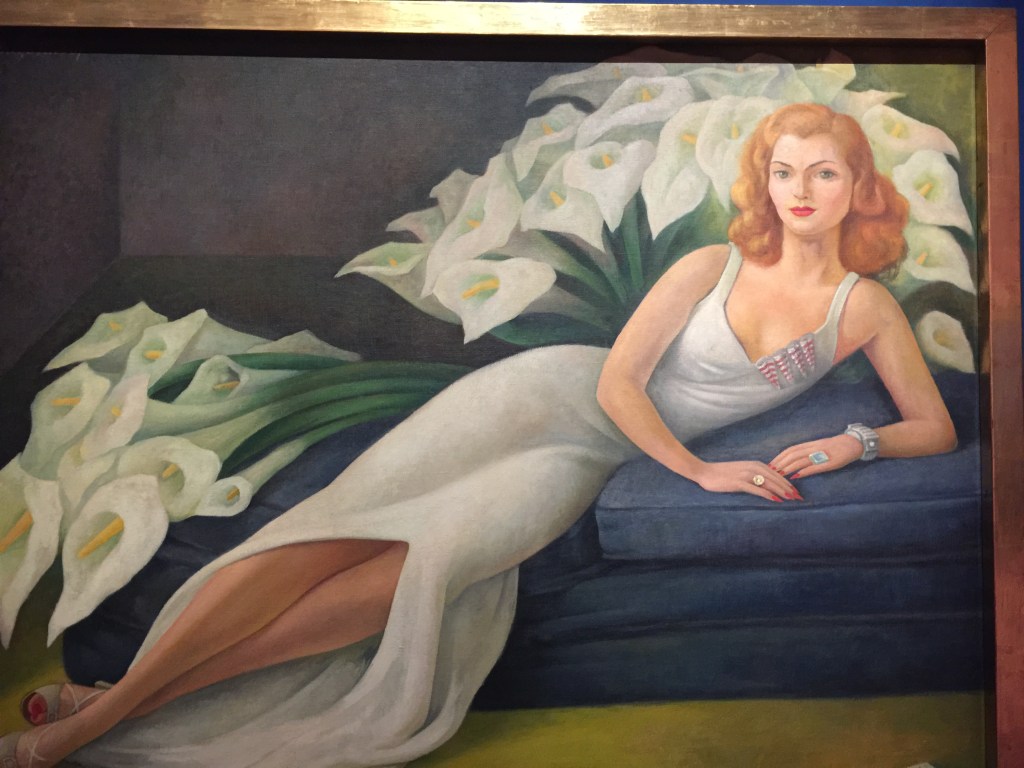
Calla Lily Vendor 1943 RIVERA
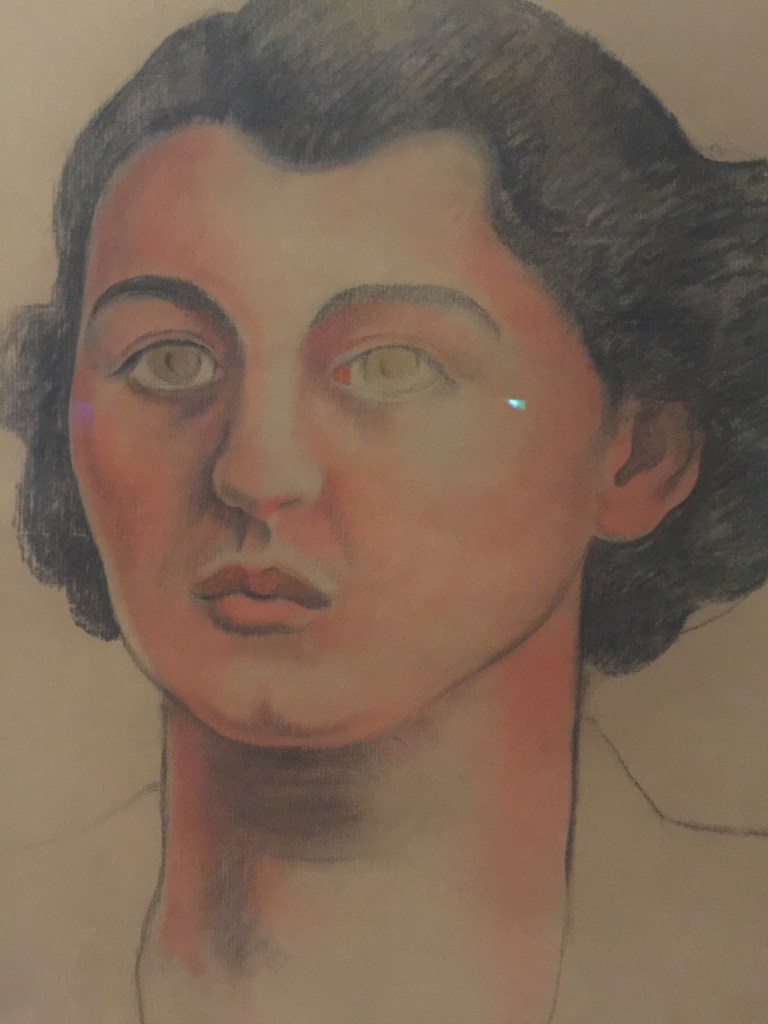
It is disappointing that there is no portrait of Frida by Diago, in the exhibition . There is, however a portrait Cristina Kahlo, who betrayed her sister.
Portrait of Cristina 1934 RIVERA
Why should Frida care, she can paint herself. Years of watching her face develop in the mirror over her bed, made her a authority of her image.
Self portrait with necklace 1933 KAHLO
Art, science and a husband could not heal Frida, they just added to her pain. The catholic and communist doctrines could not dress her wounds. Death like a skeleton hovered over her bed, like other South Americans, the dead haunted the living.
The tender call from Heaven, to heal it’s daughter was unheard, her idols were Lenin and Diego. A life without God, as we know it. However as injured as she was, she forgave. She forgave the trolly and she forgave her husband, they married twice.
Both Diego and Frida painted portraits of their Art Patron, Natasha Gelman.
by Frida
Friedas depiction has the intimacy of a woman painting another, with curls that echo the shape of the curlers, as though they are invisible and present. Her face paint, earrings and fur coat are fashionable, without personality and the cold gaze of her eyes, reveals very little of her character. The clothes , like Frida’s costumes, distract us from the truth within. Frida does not depict a content person, the eyes seem to linger on an unhappy memory.
Portrait of Natasha Gelman 1943 RIVERA
In contrast, Rivera’s portrait of Natasha is a much more dramatic and sensual with a statement of glamorous fashion. Frieda painted her with eyes glazed over, but Diego captures a bold and defiant stare. The lily theme re-appears, (refer to the vendors) however when he painted them with the flower traders they were vibrant and dramatic, now they have lost their power, and fade in the customers abode. To Diego, she is a woman of sexual appeal.
The flowers are designed to ornament the patron, she is the principle Lily. her money can buy her a place in a Diego composition, and in return he gets a commission and a champion for his artistic inheritance.
Ironically the capitalist exchange of Art Patron and Client, harnesses Frida and Diego, despite their ideology .The Gelman’s even framed a letter written by Frida begging for money,.. a rather shallow thing to do.
They took all the treesPut 'em in a tree museumAnd they charged the peopleA dollar and a half just to see 'emDon't it always seem to goThat you don't know what you've gotTill it's goneThey paved paradiseAnd put up a parking lot
Surrealism was born during the lunch break between the wars, a century ago. What had become of the precious Earth, of life. Nothing made sense anymore. The bombing catastrophes of crushed homes and disfigured people. Normal life was a nightmare and people couldn’t talk openly anymore, so surrealism became a language also; a visual code.
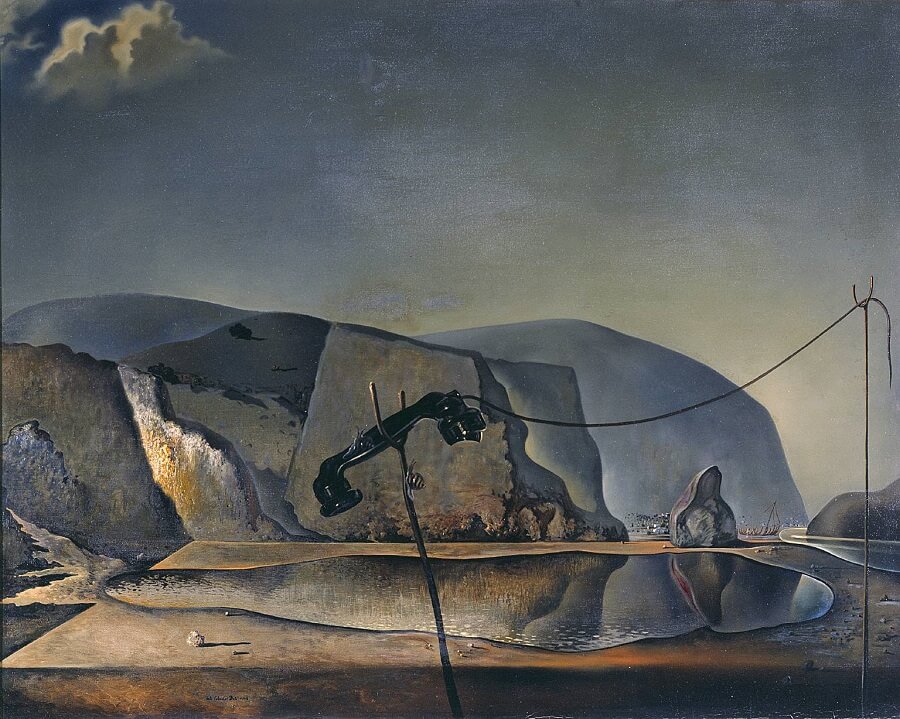
In 2009 the NGV hosted the Dali exhibition ‘Liquid Desire’ and the most haunting and disturbing painting was Mountain Lake (1938). The painting captured the helplessness of what was coming.
The backstory was that the communications between Neville Chamberlain, the British prime minister; and Adolf Hitler were cut, leading into the horrific 2nd War. Dali’s works are full of crutches, just as Melbourne artist John Brack’s shop windows, are of artificial limbs, for the war veterans that came home.
The war broke out in 1914, but before the turn of the Century the Pre-Rapaelites were encouraging people to return to nature.
What will the artists say now. Apartments have become prison cells. We need to think in our isolation, where Australia will be in the future. Not just for us, but for all of us.
The power of the word is omnipresent, we can all view it in unique perspectives, and although many witness it , at the same time; our moment is personal. The word ‘universe’ translates as ‘one-short phrase’. One Word, in a biblical sense created life. Words are used daily to encourage, to hurt , to build prejudice, and so forth. Advertisers use words with the motive to sell; Evangelists use words to save souls and graffiti artists use the word to engage.
PETER DREW
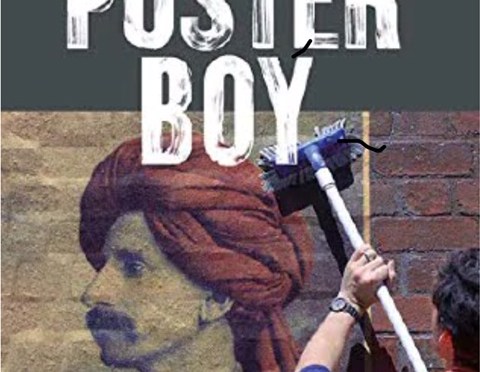
Peter Drew; Adelaide born artist has plastered the country with elegant portraits of Aussie’s that enable us to question the meaning of being Australian; a concept beyond a backyard BBQ.
“When your sneaking around the City at night you feel like a kid again.”
Drew is a peace activist that pastes a sense of reason into the hearts of the commuter. A casual glance at his picture-word statements is a thought provoking experience. He recognises that the street is an equaliser and draws the spectator into a dialogue of connection. Drew questions identity and inclusion. In a hi-vis vest, the artist has plastered up to 4000 artworks with a glue bucket and a broom.
What began as local phenomena, has boomed into an International experience; his reaction has become a political dialogue. He is an Artist with a message.
JEAN-MICHEL BASQUIAT
The NGV is currently hosting an exhibition that highlights the rise of New York Artist Jean-Michel Basquiat whose career began with writing simple and convoluted statements on city walls, under the identity of SAMO. Influenced by Andy Warhol, the artist leapt from advertiser to agitator, using the concepts of ownership and branding in a broader concept.
Basquiat entered the art scene as an urban nomad notorious for couch-surfing and graffitiing the homes within which he stayed. With word and form the artist took ownership of the material, ownership was translucent, a tender shift from theirs to mine, with a simple C within a circle around it and it was copyright; it was his.
Within the Warhol tradition the ‘Radiant Child’ used graffiti to promote his brand and identity, the ME generation was born, already bored with life. Basquiat however, possessed a passion that his mentor lacked; a statement involving the treatment of the ‘Black People’ in American.
History of the Black People 1983
ARTHUR STACE
Mr Eternity was a media title endowed upon a graffiti artist that wrote the word ETERNITY in perfect copper plate using chalk and crayon around the streets of Sydney for over 20 years. He kept his identity secret, until he was caught in the act. On the New Years Eve of 2000, the Harbour Bridge blazed with the word ETERNITY in honour of its humble artist.
Arthur Stace was a broken man when he walked into a Church for some tea and rock cake. He was an alcoholic born into domestic violence and palmed off to foster care, he fought in WW1 and lost the mental battle. Waiting for his cake and tea he was subject to a sermon that resonated within him and he became transfixed with the concept of eternity. He left the Church in the dark and broke down into tears, beneath an urban fig tree. This was his turning point, he never drank again.
“You’ll soon be back in the gutter again.”
Local police scoffed at the ‘new man’. He was back in the gutter but this time , not to lay in it, but to save souls and feed the homeless; he was on a mission. His practice was to rise at 4am, help the homeless and graffiti the word ETERNITY though-out the City.
With the St Kilda Festival scheduled on a Sunny Sunday, I set off in the opposite direction of the beach and into town to the Art Gallery, hoping that the festival would draw crowds away from the Escher exhibition. What I wasn’t expecting was a Metro meltdown.
No buses, no trains and no trams! The 246 bus decided to by-pass my area, in an effort to avoid picking up or dropping people off to the bayside shuffle. The trains were off, due to track work and the trams had a ‘disruption’. The lone carrier was the notorious ‘Replacement Bus’ that answers to no schedule.
Boarding the bus required tactful manoeuvring as the commuters jostled for a seat and standing room, the less skilful were left behind. Just as the ‘Replacement Bus’ has no timetable it also has no set route and maundered it’s way through the inner suburban neighbourhood, like a scenic tour.
I passed places where I used to live and Cafes I once frequented and what began as a commute had become a journey, instead of taking 45 minutes to reach my destination, I arrived at the Gallery, after 2 hours. The girl at the ticket desk, attempted to talk me out of buying a ticket, as only an hour of viewing remained. My restraint was thinning.
Despite being rushed through the exhibition by enthusiastic guards saying;
“30 minutes to go and 6 more rooms!”
“20 minutes to go and 4 more rooms!”
“10 minutes to go and 2 more rooms!!”
The one prediction in my favour was that it was not crowded.
The exhibition soothed my fatigue and quickened the light of inspiration that thrives beneath the surface of mediocacy. Escher is a Master printmaker, designer, artist and architect; it is of no surprise that his father was an engineer. The exhibition weaves through the development of his style and skill, which is illustrated within landscapes and town streets, that journal his travels through Europe
The exhibition combines the Art Star with the works Nendo that compliment the show, with ambient structures and light shows. Like an Escher’s design; the art patron is led through props and floor space that dupes the eye and challenges those that are prone to vertigo. The layout of the show combines the physical and visual journey, it incorporates the optical illusion within the simple building blocks of drama. Beautiful work and a brilliantly curated.
Waking up on the Summer morning ,sipping coffee as the birds dart in and out of the garden, is bliss, even if the rest of the day will be spent in an office.
For warm weather the best time to come to Melbourne is between November and April. Australia is not built for cold weather, it is a beach culture, we endure July in houses that are poorly insulated. During Winter, the southerly winds off the South Pole shred through thin walls and coats, but in Summer it’s a cool change that swings a scorching heat into an icy gail. Melbournians wear layers because random weather changes are expected.
Summer, long weekends and Easter
When the sun is out the locals are basking. There is a mass exodus to the coast in January, Easter and Public Holidays, if your planning an Ocean Road tour during these times book early. Bayside beaches fill up and most Tourists head for St Kilda but South Melbourne and Brighton Beaches are more relaxing.
Inner city Melbournians, get up early on Saturdays and have breakfast together in Cafes, the best places fill up quickly. On a hot afternoon, the South Melbourne market has great outdoor seating under a large golden canopy, enjoy Mediterranean cuisine and a glass of wine. Expect to eat dishes from all over the world, each new flood of settlers has brought their food culture with them and each gets its day in the spotlight. Currently everything is ‘infused’ with something Asian.
Market morning
Sth Melb Market
fresh produce
If the weather turns foul, which means the ‘cool’ (freezing) change came early, head to the NGV Gallery at Federation Square and take in some Australian Art. The City is proud of its Artists but Sport is given most sponsorship. The Art is world-class but under promoted.
NGV Australia ; FedSq
Sandra Hill’s; Beyond The Pale 2010 (currently on show at NGV Fed Squ.
John Olsen
The Docklands is a relatively new development with ‘state of the art’ architecture, just behind the Southern Cross Station on Spencer St. It has a futuristic opulence , a skating rink and the Southern Star.
Trains and trams are the main form of transport and very well mapped, it’s easy to follow.The MYKI card works for locals but is not visitor friendly as you have to buy it to get around. Transport inspectors can be a bit intimidating so it’s important to get one. Currently the City has all night transport on Friday and Saturday nights.
Great places for dinner are Smith, Gertrude and Brunswick Streets in Fitzroy. It’s a fabulous block of ambitious ambiance. A historical area where hustlers and artists have had ‘their day’. but currently it is urban cool.
Melbourne has great theatre but if you want to catch a local act for under $30, after dinner there are some quaint venues; The Butterfly Club, La Mama, The Owl and Cat and The Meatworks, (just to name a few) are close to town and have their own character.
Butterfly Club City
Owl & Cat Richmond
Raglan St. Nth Melb
Mechanics Sydney Rd
Bars are numerous and many are tucked into the lane network that are the life beat of the town, most often decorated with great Street Art. Roof top bars are great on hot nights but most places have outdoor heating when it’s not great.
The highlight of Summer is the Australian Open and the best place to watch it is at Federation Square in a sun-chair. Despite Australian pride of designer beer and class wine most public places are dry. On New Years Eve drinking is banned on public Bayside beaches so cancel the beach party.
Melbourne was once called the ‘Garden State’ as we like our trees. When its too hot for the beach there are great Botanical gardens and the Ripponlea Estate offers shade and a cafe. The changeable weather has created a fashion consious culture and there are plenty of shopping strips and malls to cater for discerning tastes or a bargin.
Mirka Mora @ Gorman
Bridge Road
Menz Club
Summer essentials are thongs and light coat. We all talk about the weather; we complain when it’s hot and when it’s cold.
‘Summing them up as morbid or deathly, but their very primitiveness, their sledge hammer effects, reinforce this mentally; naked extreme art’
Profoundly Art-Critic G.R.Lansell is describing Peter Booths early ‘Field’ work, a slate of black and grey on a minimalist canvas however he could have been describing his later dramatic figurative art.
Although the artist’s work morphed into an entirely different style, the essence of the artist’s style was conceived.
The Field exhibition launched Melbourne’s art scene in 1968 however it was not fully embraced by the locals.
The battle between Figurative Art that was the flagship of the Melbourne art tribes such as the Reed’s at Hiede and the Boyd’s at Murumbeena, had rallied against the American influence of the exhibition. At the time the exhibition was not organically Melbourne, nor was it entirely ‘International’.
The New York art critic Clement Greenberg criticised the first NGV Contemporary exhibition as ‘ second-rate.’
The exhibition aimed at awakening a sleepy town, after the failure of the 1956 Gallery of Contemporary Art. The new NGV curator John Stringer thrust his ideas forward and imposed his stipulations on the artists; they were happy to comply as careers and reputations were being made.
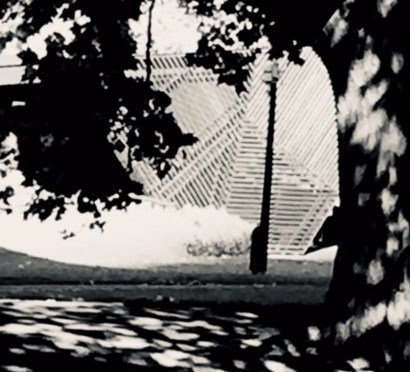
In today’s climate the work stands the test of time but to mark the journey of the Abstract Movement there is no greater example than Ron Robertson’s ‘Vault’.
The Vault 1978
The Vault was placed in the City Square in 1980, twelve years after the exhibition but the local reaction marks the cultural journey of Melbourne. The sculpture received such disfavour that it was nicknamed the ‘Yellow Peril’ by journalists and removed from its place due to public demand. It was a displaced work and was thrown into the shadows until 2002 when it found its home outside the Australian Centre for Contemporary Art.
Dale Hickey Malvern 67
Dale Hickey 1967
The art of The Field exhibition sits comfortably within our minimalist technological community . The ideas that may have seemed cold, isolated and sterile during the ‘flower power’ period have a greater relevance in 2018, within a world disconnecting with nature and embracing the virtual.
The Field Exhibition was the first piece of the NGV journey that began in 1968 and was 50 years before its time.
The show stopping art storm is fixated on capturing the Melbourne imagination with no expense spared, and this year it is free.
The journey starts and ends in the Moroccan coffee house but our focus is on the second floor, up the Reko Rennie elevator, an elevator that is part of the Galleries structure; not imported. From the Australian Aboriginal world, without excess to the post-communist decadance, up the spine into the heart and soul of the human mind.We arrive at the GOU PEI exhibit, a Chinese Fabric Artist that engineers her Masterpieces, stitch by stitch, bead upon bead, golden thread and a mantle of dreams. Inspired by an ancient past with dresses that would inspire the Pope. Her exhibit arrived in Melbourne, as precious as the Emperors Palace treasures and is located in the eye of the TRIENNIAL storm at the NGV.
Pei claims her work denies what it succumbs to, human vanity. Heart, soul and creativity, with a barrage of craftsmen on the floor, and this has happened before, in Dynasties past, a royal glass slipper for the ball. Rhianna , contemporary Diva, herald in the Artist at the Met Gala, formally the Costume Institute Gala, in New York.
The NGV hive, houses the Queen in an exhibition that begins in a blaze of glory.
Like Michelangelo, one can imagine that she is ripe for Vatican success.
The NGV has gone wild, Curated by Simon Maidment’s team, a wonderland passing from one installation to another, a mind altering experience of Art.
As art-life drifts out of the fringe into the mainstream an unholy alliance bridges the gap between today and tomorrow. The current stream sedating, a war brewing.
Guo Pei couture
Mueck’s sculptures
It’s an epic bombardment, a Cultural revolution in it’s full thrust of life bordering on the ruin of decadance. Ron Mueck explores the human condition and its vulnerability in the wake of God-like delusions.
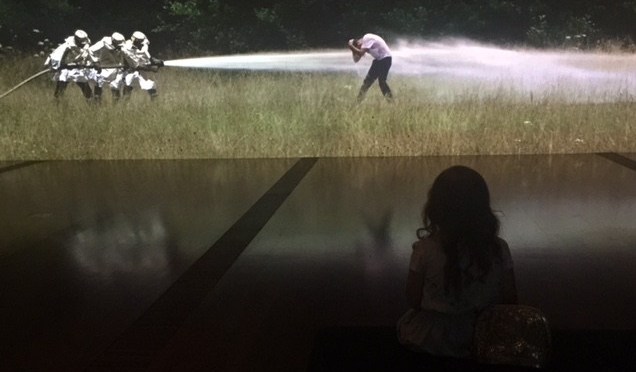
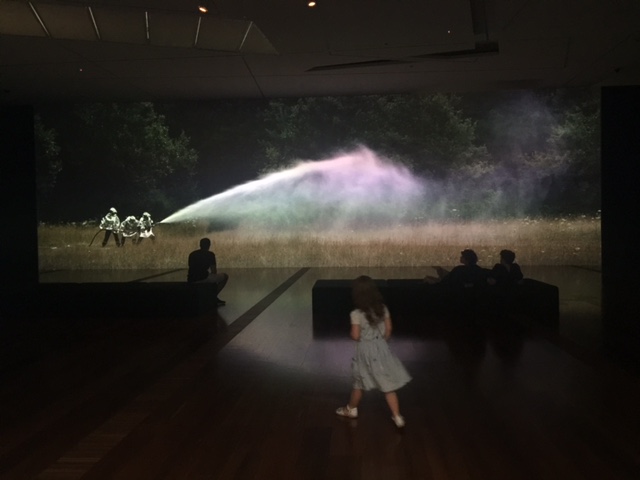
Artist, Mel O’Callaghan explores these questions through her dramatic Video Art currently on display at NGV Australia. Resistance and endurance is a rite of passage each of us will pass through eventually, a relative condition at every age.
Ensemble within the NGV space is cinematic, with life-size actors in a war-like water-battle. O’Callaghan uses the violence of the force to explore existence. It is when we let go , that life spirals and the body is swept away.
‘What a single body is capable of when enduring a voluntarily experience of duress is a powerful thing to behold’ Callaghan
Australian O’Callaghan lives in Paris and gave a live performance at the Serralves, taking it out of the dark theatre space and into the light of day.
O’Callaghan considers the body as a vehicle of ‘imposed labour’. The resistance of a ballet dancer perhaps or an underpaid worker forcing him/herself out of bed? Consider the Soldier preparing for death, or worse. Each day we battle, not to win, just to remain standing.
‘To fall, to begin again which is where the virtuous aspect comes into violence. It’s not being purely negative but rather a creative force’ O’Callaghan
Her work also relates to the Political and Economic climax point that is coming into focus.
‘…. those mounting feelings of deep despair that force acts of extremism’
French designer Christian Dior craved an artistic life as the economic world collapsed under the weight of the war machine that had eaten into Europe. He fell into the company of artists, and sought the bohemian path in the aftermath of terror. They had new hope, a brighter path, where he could be an artist or an architect and became a Fashion Designer.
Dior learnt the sophistication of simplicity through his training with designer Robert Piguet from 1937, yet his spatial designs grew out of his visual comprehension of Architecture, creating elaborate folds and abundant material to create contrasts that would highlight a slim waistline through his A-line skirts that dropped just short of the floor to make the model appear taller.
“I drew flower ladies” Dior
This return to the former traditions and the excessive indulgence of fabric angered the post-war women that had achieved a degree of independence through taking on jobs during the war that required a higher hemline and sensible attire. Material was still rationed and his designs also mocked the practice accessibility of the ‘new look’.
“The women were very closely tailored and it wasn’t easy, there was no freedom, morally women were veering toward a freer , more equal way of being, of course 68′ proved this many years later. Dior was fastening them into inconvenience with skirts like the BON BON dress that must have used 30 meters of fabric. It was tailored to the waist……tight fitting shoulders..breasts lifted with bra and corset, the dress even had an inner frame”Pierre Cardin
Dior’s vision was a cog that sent women back to the home, as the men returned from war and re-entered the workforce. Fashion that ornamented womens figures, new kitchens and pushing prams was the road into the 1950’s. Celebrities, Royalty and Movie stars modelled his frocks and set the scene in womens magazines for women to admire and sew.
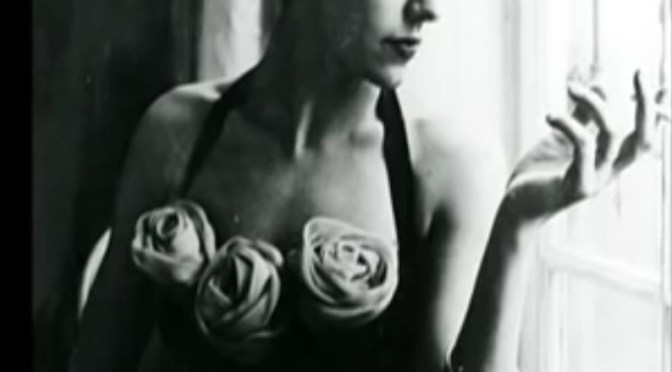
Dior designed all of the dresses worn by Marlene Dietrich in Alfred Hitchcock’s classic ‘Stagefright’.
“So long as I have the dress I am the one who decides how long this show will run, .. and everything else ” (quote from movie Stagefright)
Dior did not enjoy the celebrity life, he preferred life outside of the spotlight of his Haute Couture kingdom, however his business acumen rarely failed him. Despite his success, he didn’t have a Fashion House until he was 42 years of age.
‘Australian women were among the first outside of Paris to witness, model and purchase original Dior designs. Less than a week after Dior’s dramatic debut of February 1947, articles celebrating his talent appeared in local newspapers.’ NGV
Up until the late 70’s most women could sew clothes for their families and magazines promoted dress patterns over shop purchases. Fashion designers had to be a step ahead of their acute audience and the dazzle of Dior’s complex silhouettes continued to challenge women who tried to make what few could afford. David Jones (Sydney) presented a Dior fashion parade in 1948.
The elegant French designs were tempered into frocks that marked ‘the look’ of the 50’s. As fashion relaxed in the 70’s, puffed up in the 80’s and went grunge in the 90’s, the Dior sophistication excites a retrospective desire for elegance.
During the week the NGV was wall to wall with women visiting the gallery, marking the Spring Carnival of fashion in Melbourne.
Christian Dior The Man behind the myth, Phillipe Lanfranch
“It’s always been about sharing stories, identity loss and grief, determination , imagination , self belief, cultural integrity, hope and justice, reliance , cultural pride, and more than anything it’s about my people’s survival of spirit.” Hill
Noongar woman, Sandra Hill was a stolen Aboriginal child that was forced into foster care at the age of seven by the Australian Government due to the Assimilation Policy that was still active in 1958. Four children were removed from their mother’s house, they included her self , her two sisters and a brother. They were the 3rd generation of children removed from this family line.
‘In 1994 Hill was employed as the Aboriginal Community Cultural Officer. During this period she applied for, and was awarded, a Creative Development Fellowship from the Aboriginal and Torres Strait Islander Arts Board of the Australia Council for the Arts. This afforded her the time to carry out research relating to her life experiences as a member of the Stolen Generations’ (extract from Design & Art Australia on-line)
Hill’s work is held in many private collections and is also represented in Major Art Galleries throughout Australia, currently her mixed media work “Beyond the Pale’ is on display at the NGV Ian Potter Gallery at Federation Square in the Australian Art Exhibition. She explores domestic labor as part of the ‘Assimilation Project’.
In the past, Domestic colleges were set up to train poor white girls and ‘half-caste’ Aboriginal children to attend to the needs of the wealthy.
‘In the early issues of Home Beautiful there was a feeling of nostalgia for the passing of an age in which almost everyone in the middle and upper classes could afford to keep a live-in maid. Even at the turn of the century , architects and designers were discussing the ‘servant problem’ and trying to come up with ways to help women face a future without servants’The Australian Home Beautiful, from Hills Hoist to High Rise.
NGV
ref: page 73, Household Help: The Servant Problem. The Australian Home Beautiful from Hills Hoist to High Rise Hardie Grant Books Oliver J.
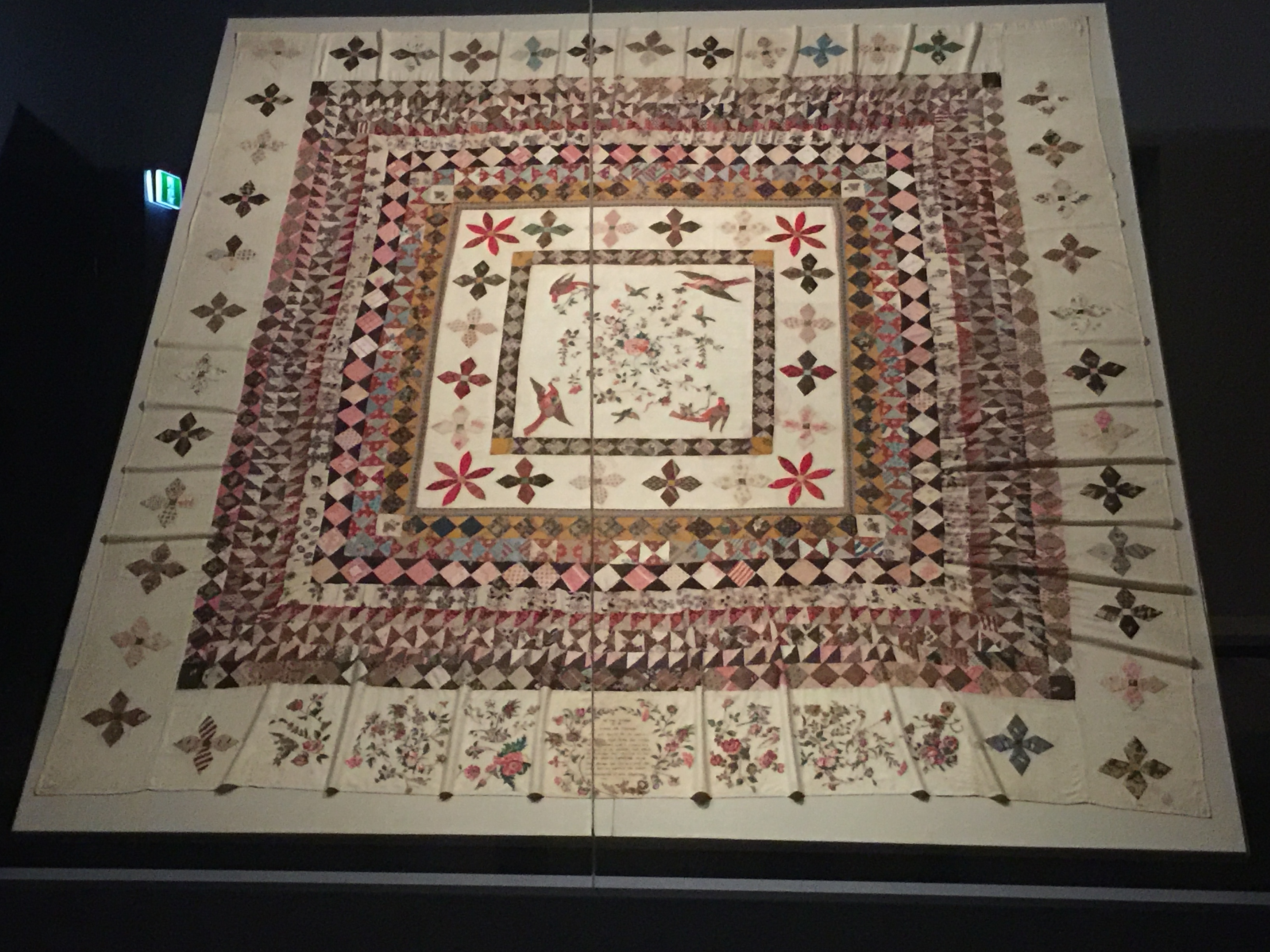
It’s fascinating to imagine that female convicts on ships to Australia, were sewing beautiful quilts. They were leaving heavily populated cobble streets and embarking on a tour into the wild unknown.It was a place where currency was rum, women were few and some unthinkable dark terrors took place.The unfree made free and the free made unfree.
The Rajah Quilt
This quilt was created by the women on board the Rajah in 1841, they were taught by Elizabeth Fry, a Quaker reformer.
‘The Australian quilting tradition developed in response to a unique set of factors that sets it apart from other quilting traditions internationally.’ NGV
There was the odd sailor that picked up a needle and thread and made his own quilt.
unknown artist
This example is a work of Art, an intricate geometric design, with a contemporary feel. The beauty of the quilt is that it is also functional. The time poured over the work creates a meditative element that transfers an emotional or spiritual quality to the work.
Enter a caption
During WW1 and WW2, ‘quilts were a means of rallying support’.
To this day, some churches still create quilts to place over the unwell. The quilt can also serve as an historical piece, recording the members of a congregation, club or school.
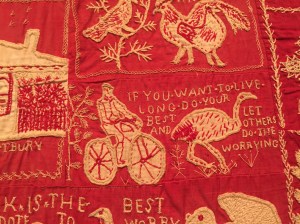
Some stitched a bit of wisdom to guide the next generation.
The Westbury Quilt 1900-03
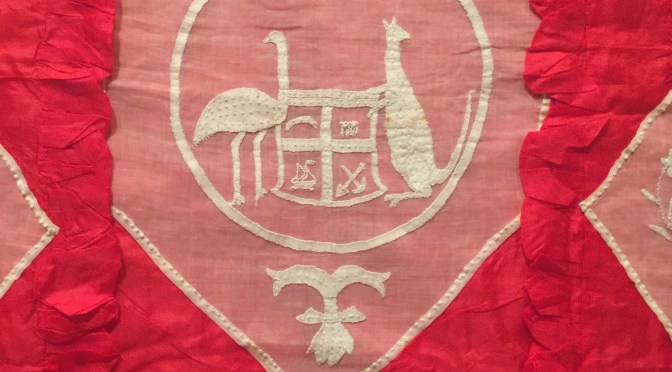
The charming Westbury quilt was created by a Tasmanian family, it was intended to be a raffle prize. Its a mix of British domestic influence and Australiana.
Mariann Gibson Crazy Quilt 1891
Others competed to be the ‘craziest’ of the ‘crazy quilt’ fashion, that was the sewing movement at a time, when European Art was shaking off the shackles of the past. The British settlers had no cultural roots in Australia, they could push the boundaries of traditional Arts.
The Goodnight Quilt by Mary Jane Hannaford
Some caught the eye of the galleries to be immortalised. Mothers often sewed quilts for their children or were given to them by a loving friend or family member. Mary Jane Hannford’s ‘Goodnight Quilt’ was made for her 11 year old grandson.
‘The subject matter of Hannafords quilt includes patriotism, religious faith, the love of Australian wildlife and the marking of key family events’
Nursery Quilt Artist unknown
Some works were sewed roughly, not for beauty or art but for warmth. The gathering of discarded clothes, recycled into a rug. The perfect art for Depression and War when materials are few and patience is limited.
Wagga
‘real rag bag waggas, hessian bags or patchwork-covered army blankets, but still rich in the memories embedded in their cloth.’ Annette Gero
It’s a pictoral exploration into our past, through fabric. Mostly, but not exclusively a womens history. Sewing groups were also social and community acts. It’s an engaging exhibition.
During war years, the Melbourne art scene dragged itself away from the safe bush scenes and began making social comments through expressive art. Urban hardships were the realities of the day, and the war brought home Surreal experiences. The struggle for survival opened up a marginal void, that the new bohemia were ready to fill. Eccentric aristocrats were the lifeblood of Melbourne Artists during the new Modern Movement. There were two major camps that drew in the cream of new art. The Reeds established a shelter for artists at Heide, in Heidelberg and Meric Boyd’s ‘Open Country’, in Murrumbeena, challenged the status quo.
Both had an open door policy for emerging artists; Meric Boyd built a kiln on the property and encouraged his children to be active in the hub that gathered there. The kiln would eventually fire-up Arthur Boyd and John Perceval’s, emotive and provocative sculptures.
John Percival The Acrobat Angel
Perceval; The Acrobat Angel : Boyd; 30 Pieces of silver
Boyd’s style grew in Open Country but manifested in the South Melbourne paintings. During the dark war years, he suffered from a depression.Like Perceval he saw the depravity of urban life and drew upon motifs that would be symbols to became part of his pictorial dialogue.
Arthur Boyd the Ochard 1943
‘the man in wheelchair, the cripple on crutches, the tormented naked lovers, the beast, the chimney stacks and the gargoyles.’ Sasha Grishin
Boyd, Percival and Tucker explored the moral decline brought on by the American troops stationed in Melbourne; the confronting work does not shrink from climate of prostitution in the City. England sent Australian troops to India to guard its riches and the Americans stepped in to protect our land and befriend it’s women.
Albert Tucker Victory Girls 1943
The Reeds harboured Sidney Nolan as he avoided military duty and the Kelly series expressed his new outlaw status.Nolan was Sunday’s prize bull, she wanted Europe to embrace him, but the modern world rarely looked our way.
Joy Hester was coaxed and chastised by the wilful Sunday and she would occasionally slip over the river to the Boyd’s camp. Tucker would have a love/hate relationship with the Heide crew, as his personal involvement with Hester intensified.Their Love Child Sweeny, brought Mike Brown into the brood during the later years.
Joy Hester photo by Albert Tucker at Exhibition Gardens
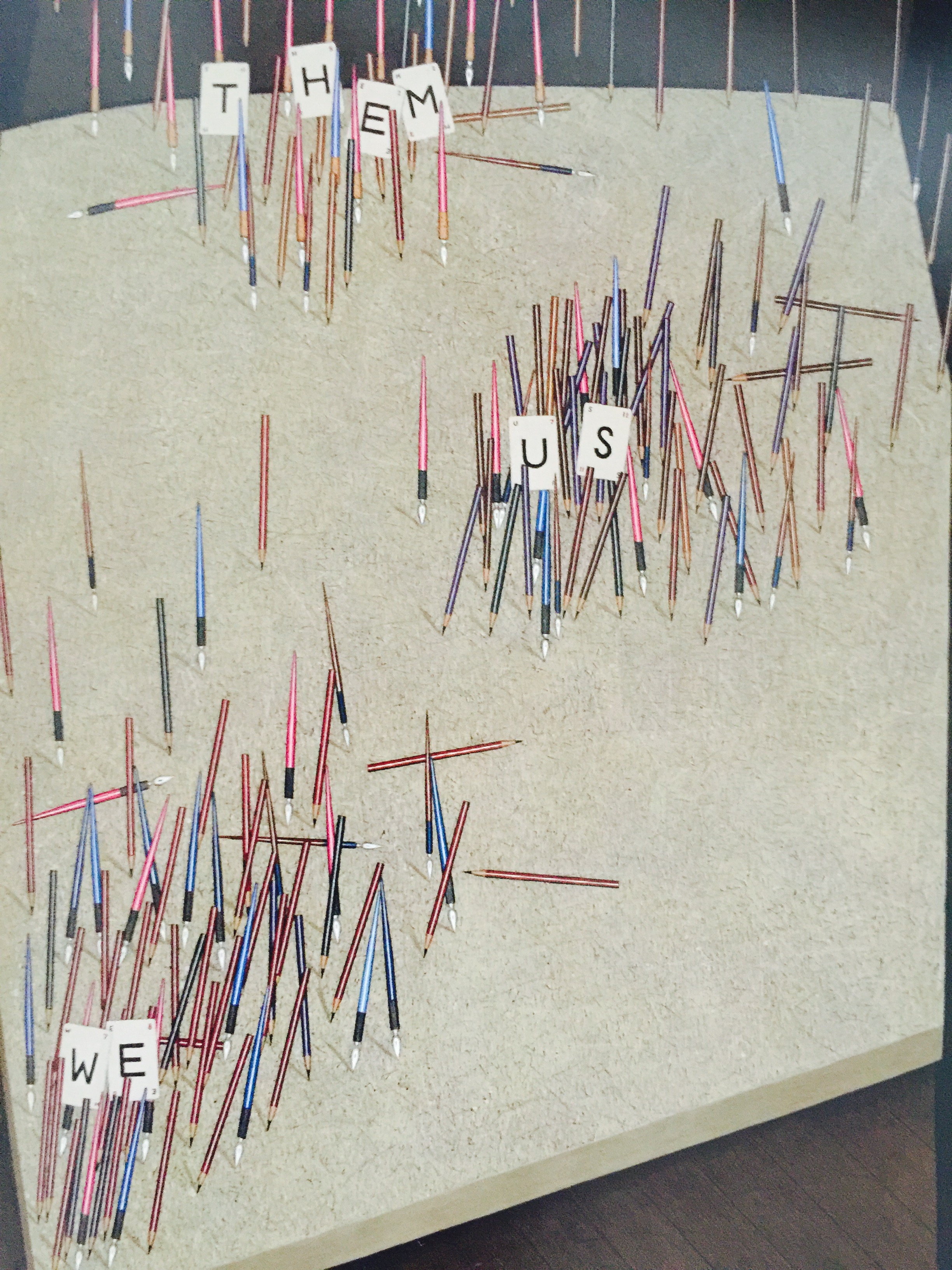
The Reeds were determined for Melbourne to be the capital of figurative art and hoped to expel the growing appeal of the American movement of Abstract Expressionism.The 1959, Antipodean Exhibition drew in artists from other camps who signed and battled over the direction of Melbourne Art. John Brack supported the figurative art stance but withdrew from the show due to the politics. He had avoided the ‘hot-bed of art groups and shared a studio with his life long friend, and fellow artist Fred Williams.
We,Us,Them 1983 Bracks comment on human behaviour
During the war years the Paris Art scene was kept in darkness. American Abstract Expressionists stole the limelight, it could have been the Australian figurative movement and for good or bad, it could have led world art into the heart of Melbourne. It was a radical and unique period in art history.
The other major art groups in early Melbourne were Dunmoochin which included Clifton Pugh and John Olsen. Montsalvat was set up by Justus Jorgensen and drew strongly from European influences, particularly in its architecture.The town was relatively young and most of the artists had studied and knew each other through the Gallery Art School.
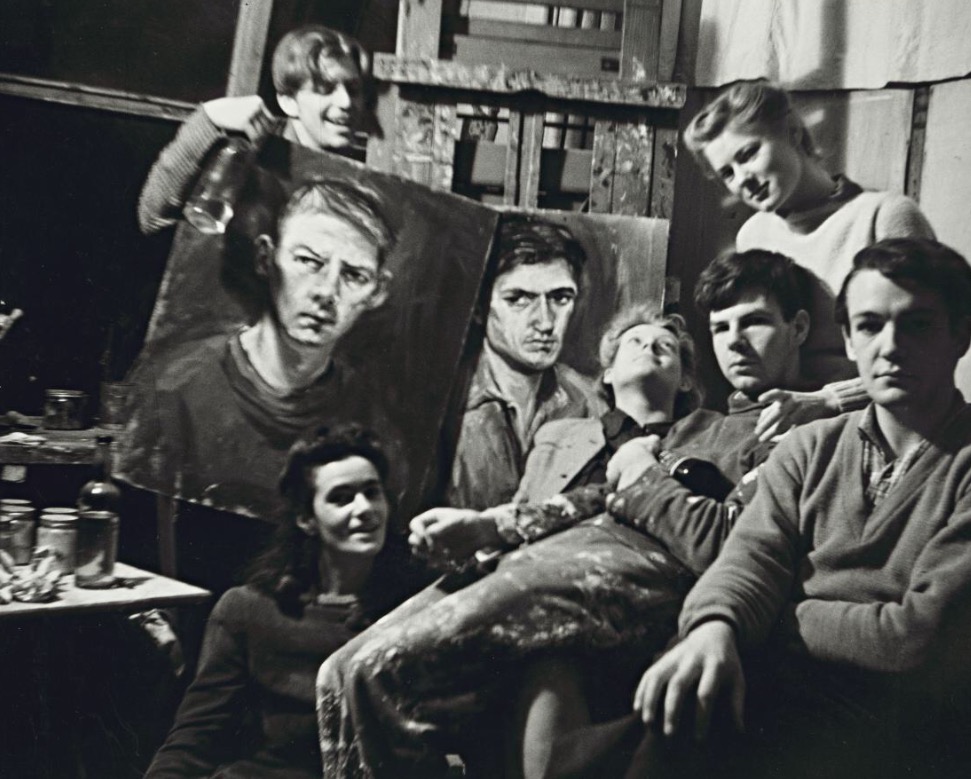
Mirka Mora arrived in Melbourne, like many immigrants, her family was escaping the persecutions and atrocities of the war. Local artists frequented the Mirka coffee shop and Mora flirted between Heide and Open Country camps.She sewed a dress for Sunday and her children played amongst the Boyd’s kilns. She supported Joy Hester by exhibiting her on the café walls and as her families hospitality businesses grew, so did her presence as an Artist.
Mirka Cafe opening
Charles Blackman was a regular customer at Mora’s cafe, the family had a reputation for supporting and feeding local artists.Despite the energy and personal finances Art Patrons offered, the artists knew that they would have to leave Australia to further their careers. The public enjoyed modern housing,appliances and clothes but they were closed to new ideas and clung onto Colonial Art.
Open Country at Murrumbeena
‘In 1963 after having achieved a degree of recognition and financial security, Percival and his family joined the general exodus of artists and left Australia.’ Sasha Grishin
Boyd had already moved his family to England. Open Country was torn down, to make way for a block of flats.
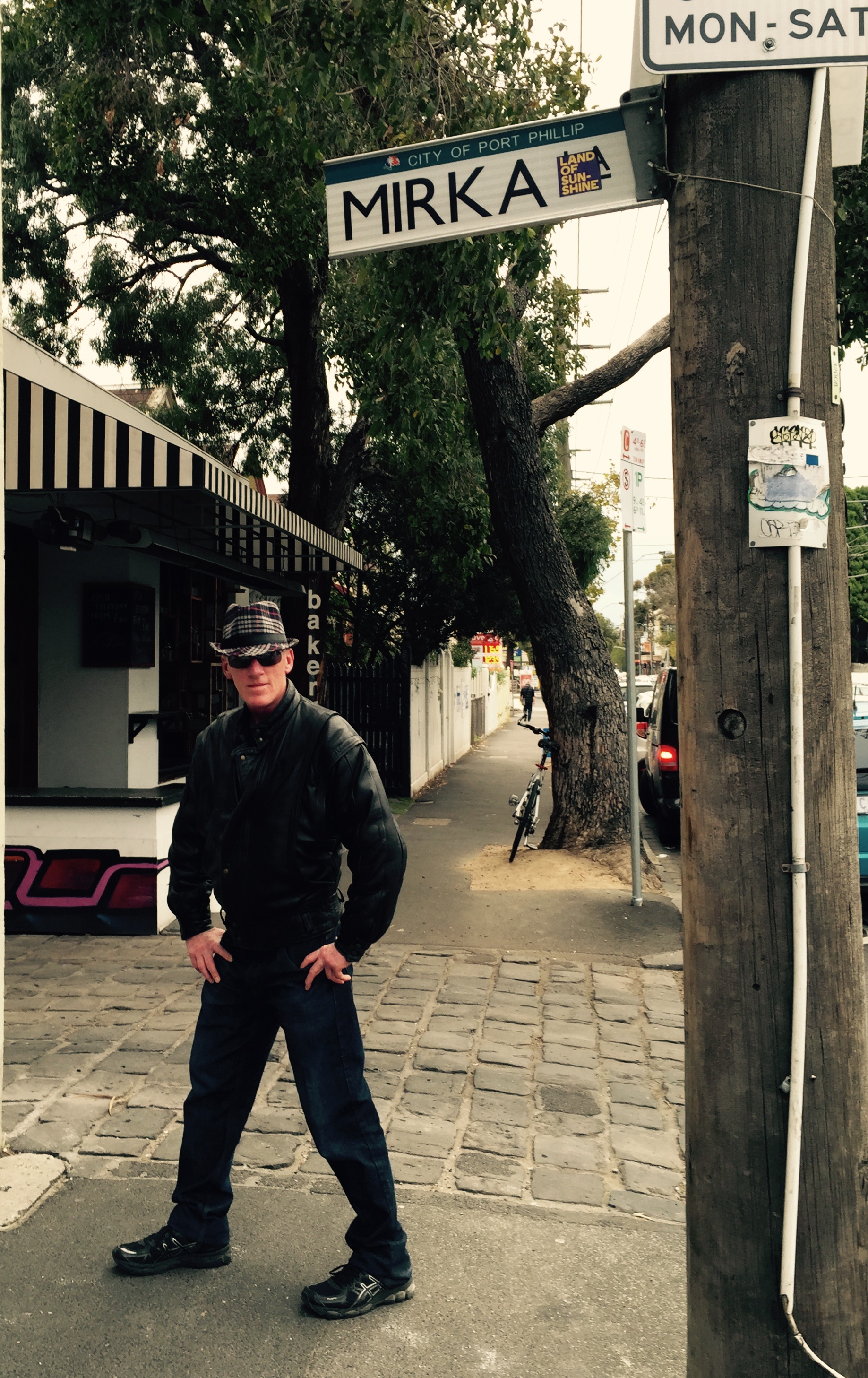
Mirka Lane with St Kilda local
Banner Photo Athur Boyd butterfly Man 1943
John Brack NGV 2009; p156
Australian Surrealism and its Echoes NGV 2015; p70
The Heart Garden Sunday Reed and Heide Janine Burke Vintage 2004
Australian Art A History, Grishan S, The Miegunyah Press,2015; p333-347
200 years of Fashion at NGV Australia is a fashion warp of cultural remembering. It is commonly acknowledged that written history is told through the eyes of the ‘white man’, Aboriginal history through Art and Womens history through fashion.
The Suitors
This bride isn’t shrinking away from a bold statement, there will be 2 suits in this marriage.
‘…the Colonial taste (which might differ from Melbourne suburb to suburb) was capricious, so different as to be sometimes absurd.’ Margaret Maynard
Revolution
‘Australian fashion from the early twentieth-century broadly emulated international trends and ideas of glamour inherited from Paris and Hollywood, but by the 1960’s, Australian designers were beginning to have there own impact on the world stage with work that no longer followed..’ Nadia Buick
Its political; burn the bra,womens lib,sexual liberation due to the pill & frighten your parents all at once.
Prue Actons ‘Youthquake’ reveals a sheer jumpsuit that sold for $60. David Jones marketed it to mainstream as sexy but for the Flower Power generation; ‘it was a symbol of passive resistance .. anti- war protests..its changed attitudes and allegiances’ NGV
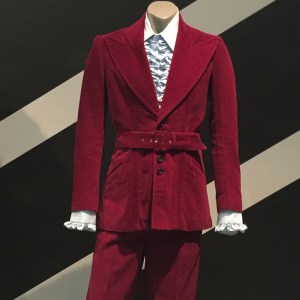
Meet Mr. John
All this suit needs is a perm,thick moustache, reflecting glasses. Its more trip than hip.
House of Merivale and Mr. John Sydney, introduce the corduroy belted suit for men in 1973.
‘The 1970’s trend towards unisex attire, which saw traditionally ascribed masculine and feminine codes of dress become more androgynous.’ NGV
As the 70’s seep into the 80’s, The Chai Jumpsuit 1978, reveals fashions ‘capacity as a medium for artistic expression’ Danielle Whitfield.
Doing time with the Pistols
the PUNK period, was no longer passive resistance, it was anarchy. The Melbourne music culture embraced punk, Sex Pistol films were played at Uni. events and the alternative scene was self supporting.
‘As the band reappeared for an encore, Sid showed the audience an obscene gesture and Steve yelled, “You must be mad to want more of us’ Dangerous Minds, Gallagher.
Less is Best for NOW
Inspired by Mondrain , conceptual minimalism and Kraftwerk.
Tina Salivas studied fashion at Adelaide’s Marston College her 2007 creation draws inspiration from European Artists.
‘the cloth contributes to the overall design of the garment..to fully realise their artistic visions …they must not only develop form, but the textile as well.’ Paola Di Trocchio
extracts from 200 years of Fashion NGV publication.
Top Photo: Kate Durham ‘Sentimenta romantica de l’amour et glamour: Wedding ensemble 1982’If this was the veil, imagine the reception.
David Shrigley’s drawings, sculpture, happenings and films follow the anti-art traditions of Marcel Duchamp and Andy Warhol. ‘This is not art, this is not important’. Then why did the NGV host his work and float his head-less toy swans in the moat.
The seduction of Art refusing to be Art is like a conquest behaving coy and disinterested. Its chic, its naughty but its mostly irreverent. It’s the cat and mouse game that the art world has been playing with itself since the 1880s when Modern Art decided to challenge the status quo of ‘what is Art?’
Shrigley has a mass appeal. Since 2005 he has produced a weekly cartoon for the UK’s Guardian newspaper. Michael Leunig cartoons, that have appeared weekly in The Age draw similar references, however Shrigleys message, is less emotive and more ‘slap stick’.
The exhibition came wallpapered, with roughly drawn cartoons and captions such as;
“I don’t have a head but still I must go to work”
The exhibition housed an interactive life drawing class where the live model was replaced by a naked cartoon sculpture, like a garden cupid fountain, it too, relieved itself. A motorized head entertained visitors and there were ‘boring’ films. The film of a cartoon figure sleeping ‘A Napping Station’, is a parody to the Andy Warhol film, Sleep.
The NGV website noted a remark by the English art critic Adrian Searle.
‘Shrigley’s work is very wrong and very bad in all sorts of ways. It is also ubiquitous and compelling. There are lots of artists who, furrowing their brows and trying to convince us of their seriousness, aren’t half as profound or compelling.’
The most important thing to have when examining his work is your sense of humor.



















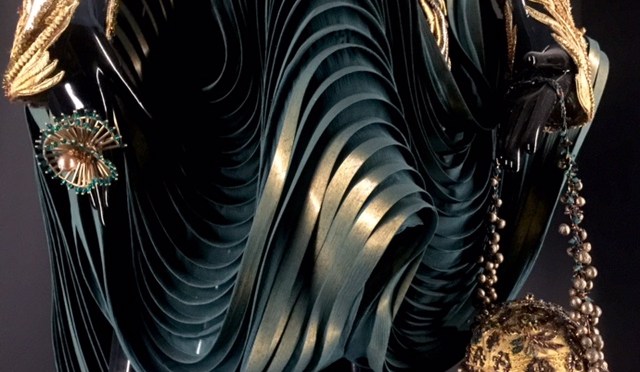


 We arrive at the GOU PEI exhibit, a Chinese Fabric Artist that engineers her Masterpieces, stitch by stitch, bead upon bead, golden thread and a mantle of dreams. Inspired by an ancient past with dresses that would inspire the Pope. Her exhibit arrived in Melbourne, as precious as the Emperors Palace treasures and is located in the eye of the TRIENNIAL storm at the NGV.
















 melbourne press