“Why were there so many good women artists working in Australia in the 1920’s and 30s, involved more with inventive, rather than imitative art?”
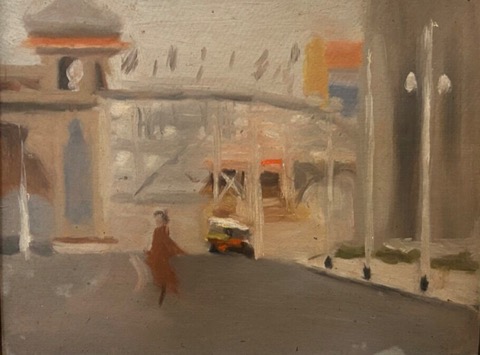
Wet Evening 1927 C Beckett
(Australian Art A History, Sasha Grishin, p219)
It takes a Melbourian to spot another; we feel comfortable with each other, despairing under the heavy grey roof of clouds, moody and cold; sharing the melancholy, the dullness and the empty vacuum of being alone within a cultural and landscape scene, of exciting monotony. Becketts urban scenes may have been painted 100 years ago, but the tone remains the same. We recognise ‘those days’ and ‘those streets’; the sound of wet rain on the road.
Beckett studied under Australian Master Artist, Fredrick McCubbin (1855-1917) in 1914, at the NGV art school when it was housed in the State Library. McCubbin is renown for his idealistic bush scenes of muted realism, although known as an Impressionist, his scenes were uniquely his own interpretation. He didn’t travel to Europe until later in his life and his art grew within the Heilderberg scene. He had studied under Eugene Von Guerard, and was influenced by his romantic storytelling, that made McCubbin a household name.
Shelling Peas 1913 F McCubbin
When Beckett studied under the older artist, he had returned from Europe and had launched into his lesser known period, where detail was abandoned for a blunter European Impressionism. McCubbin’s new focus was less colonial and more urban and this would have enabled Beckett a more local focus for her themes.
Walking Home 1931 C Beckett
Beckett however broke away from the safe confines of her masters instruction and into the edgy new scene of modern Tonists that was led by McCubbin’s rival Max Meldrum (1875-1955), known as an ‘art upstart’. Beckett was Meldrum’s star pupil and member of the exclusive Twenty Melbourne Painters Society, that broke away from the Victorian Art Society, which is an art society limited to 20, that still runs today.
October morning 1927 C Beckett
“Meldrum was in many respects an outsider, rather than an accepted member of the art establishment”
(Australian Art A History, Sasha Grishin)
Meldrum taught his students to use limited palettes, hazy outlines and attention to the breakdown of tones. He regarded he’s study of tone to be scientific and aimed to create compositions that explored light, atmosphere, space and distance. Simplified forms and how they contrasted tensions, created a structure of order, when the artist approached their canvas.
Wet day Brighton 1928 C Beckett
Melbourne’s moody skys and the strong contrast of seasons is the perfect homeland for an artist who lived and focused her work on the eastern bayside villages. Beckett’s work never received the fame she deserved in her lifetime and although she was a prolific artist, most of her work was destroyed in poor storage. A longer life may have solved the issue but harsh Melbourne winters took their toll, on a woman, her trolley and the outdoors.
Princes Bridge, Flinders Street Station and clock tower 1930 C Beckett
This typical Melbourne scene has never been captured so well, a mood many morning commuters are familiar with. Her work evokes an emotional response like a shared memory of an event. She takes us on a urban tour through her art. Her work stikes a deeply personal tone within the viewer, it’s not a story, it’s home.
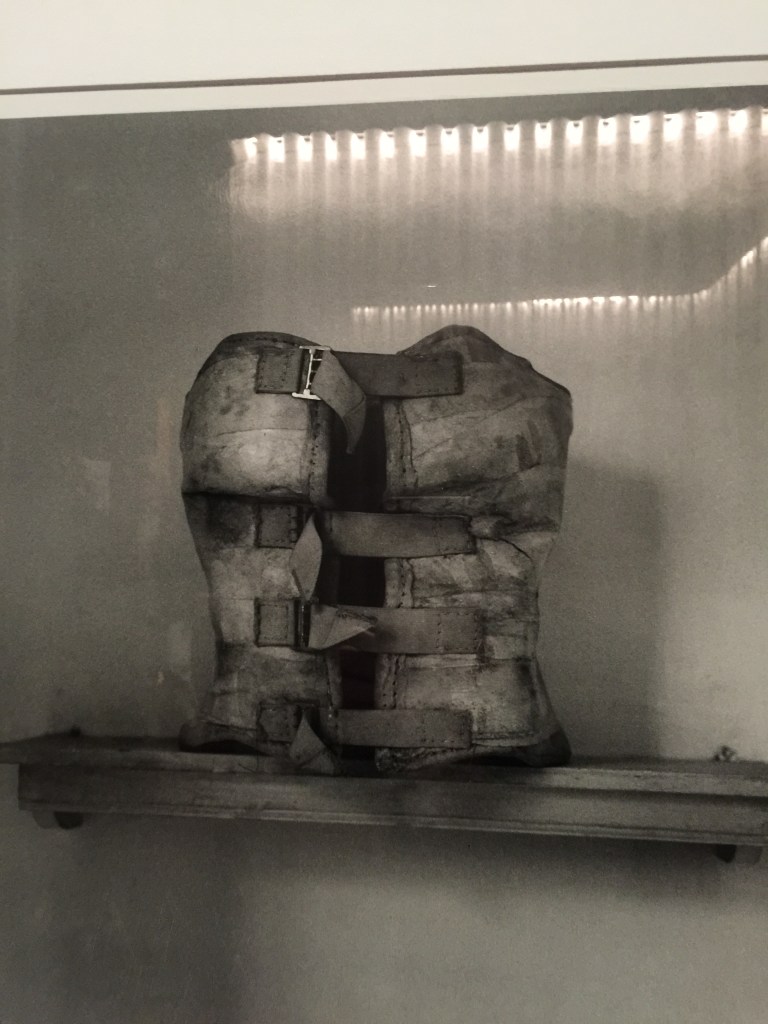
Frida Kahlo was shackled in a body, and rooted to an artist, that life had chosen for her. She may have aspired to be a doctor, and marry a young man, to have a car load of children; but this was not for her.
“There have been two great accidents my life, one was the trolly, and the other was Diego.”
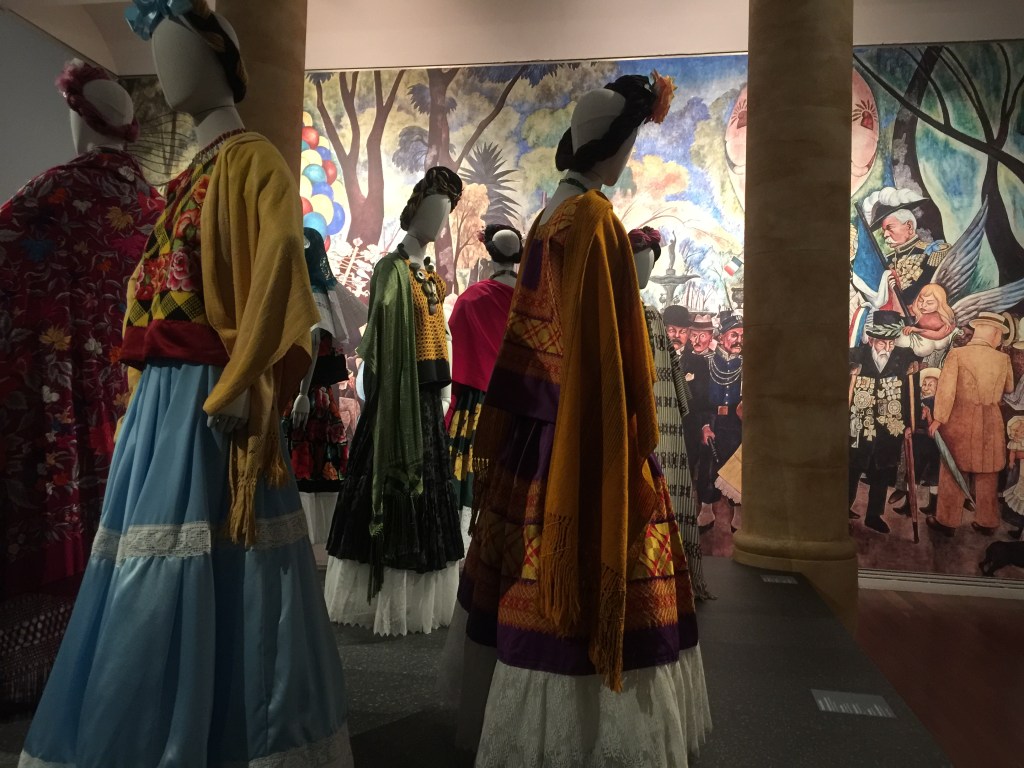
Her flowing garments distracted the viewer of the restrictions within.
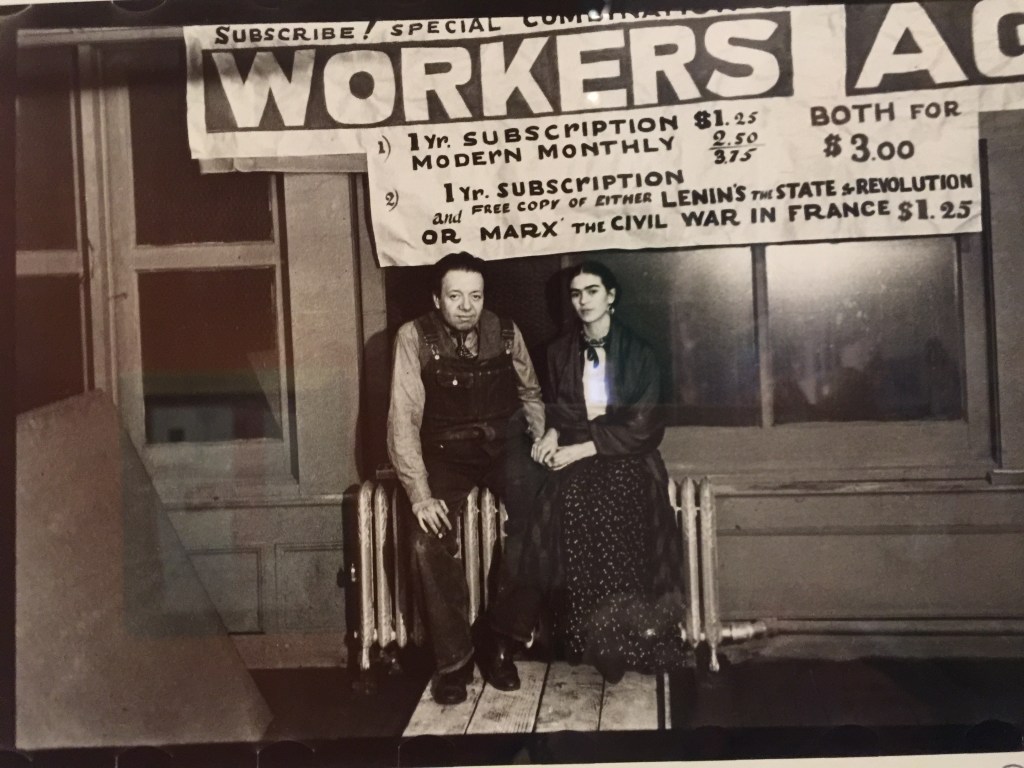
The exhibition celebrates the marriage of a Mexican couple that played definitive roles in the Modern Art movement, that of Frida Kahlo and Diego Rivera. Rivera was an artist employed by the communist party to promote the working class and Kahlo became an icon for the feminist movements.
Their marriage was not a happy one due to Diego’ affairs and Frida’s health issues. They divorced after Diego slept with Frida’s sister and reunited after many years of difficulty.
Within the deep loneliness of betrayal, she made a friend of self portrayal, documenting her stoic response to a body was held together, and coming apart, like her marriage; she was on shaky ground. The unsmiling cool demure, and films of Diego shuffling around her like a creative volcano, that was ready to explode, depict the tension.
Despite Frida bravado and staunch feminist tendencies, she was vulnerable to the whims of her husband. Somewhere within this mistress of disguise, was a frail heart, that revolved around her Rivera.
Diago on my Mind 1943 KAHLO
Diego, an accomplished artist, was 20 years her senior, who studied fresco painting in Italy and a was a Mexican art star. As a communist he was interested in the condition of the worker.
Fresco wall art 1932
In his portraits and paintings, we see the ‘lover of persons’, that Frida would have basked in. His sensitive attention to the the subject and ‘eye’ for subtle beauty is enriched in his depictions.
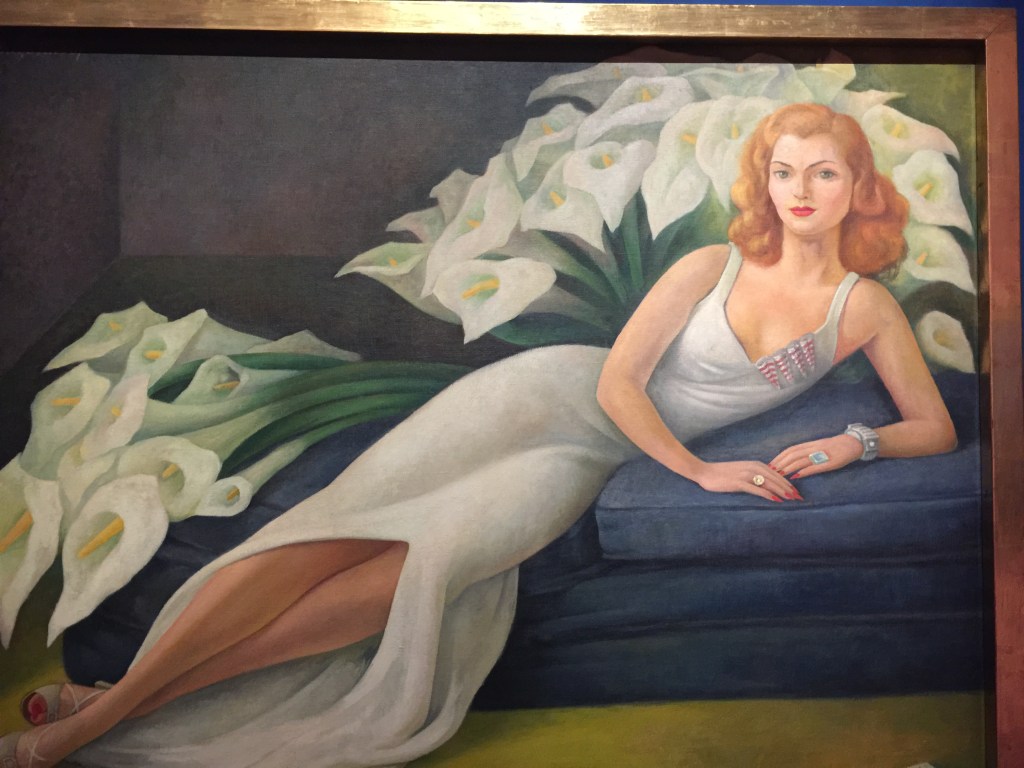
Calla Lily Vendor 1943 RIVERA
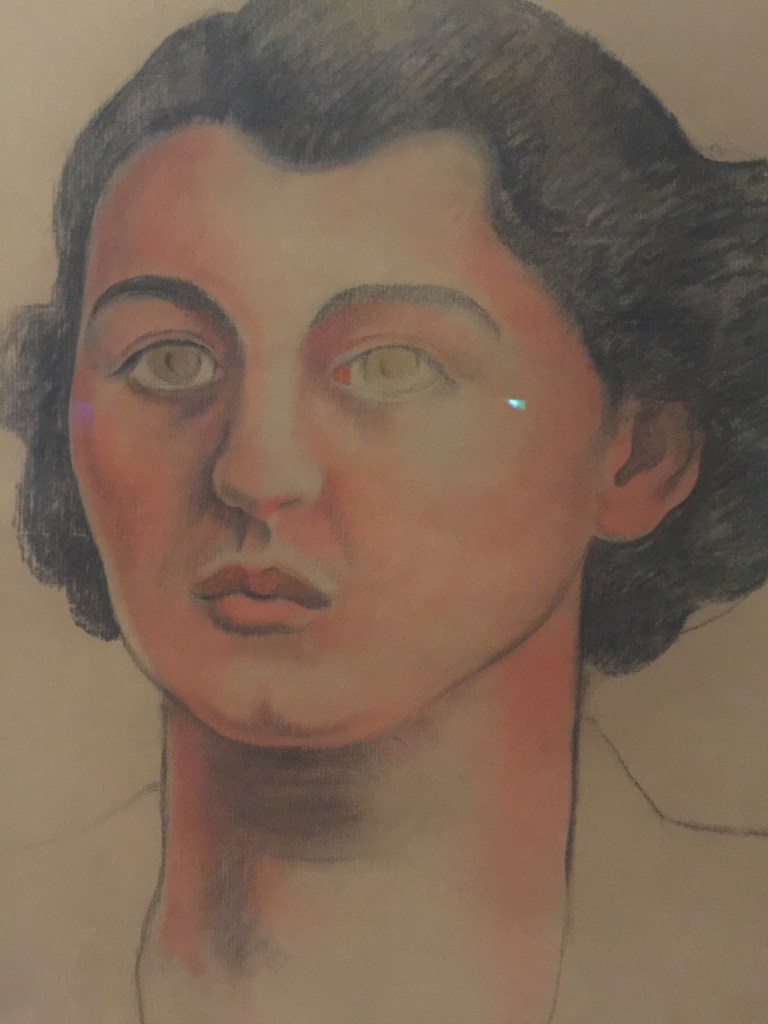
It is disappointing that there is no portrait of Frida by Diago, in the exhibition . There is, however a portrait Cristina Kahlo, who betrayed her sister.
Portrait of Cristina 1934 RIVERA
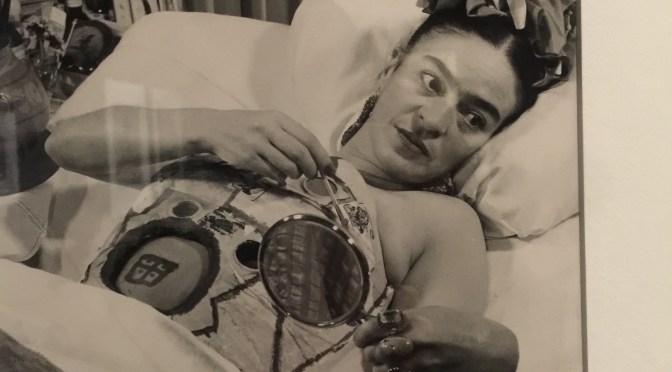
Why should Frida care, she can paint herself. Years of watching her face develop in the mirror over her bed, made her a authority of her image.
Self portrait with necklace 1933 KAHLO
Art, science and a husband could not heal Frida, they just added to her pain. The catholic and communist doctrines could not dress her wounds. Death like a skeleton hovered over her bed, like other South Americans, the dead haunted the living.
The tender call from Heaven, to heal it’s daughter was unheard, her idols were Lenin and Diego. A life without God, as we know it. However as injured as she was, she forgave. She forgave the trolly and she forgave her husband, they married twice.
Both Diego and Frida painted portraits of their Art Patron, Natasha Gelman.
by Frida
Friedas depiction has the intimacy of a woman painting another, with curls that echo the shape of the curlers, as though they are invisible and present. Her face paint, earrings and fur coat are fashionable, without personality and the cold gaze of her eyes, reveals very little of her character. The clothes , like Frida’s costumes, distract us from the truth within. Frida does not depict a content person, the eyes seem to linger on an unhappy memory.
Portrait of Natasha Gelman 1943 RIVERA
In contrast, Rivera’s portrait of Natasha is a much more dramatic and sensual with a statement of glamorous fashion. Frieda painted her with eyes glazed over, but Diego captures a bold and defiant stare. The lily theme re-appears, (refer to the vendors) however when he painted them with the flower traders they were vibrant and dramatic, now they have lost their power, and fade in the customers abode. To Diego, she is a woman of sexual appeal.
The flowers are designed to ornament the patron, she is the principle Lily. her money can buy her a place in a Diego composition, and in return he gets a commission and a champion for his artistic inheritance.
Ironically the capitalist exchange of Art Patron and Client, harnesses Frida and Diego, despite their ideology .The Gelman’s even framed a letter written by Frida begging for money,.. a rather shallow thing to do.









 melbourne press