AUSTRALIAN MOVIES (survival)

Lantana

Directed by Ray Lawrence. With Anthony LaPaglia, Geoffrey Rush, Barbara Hershey, Kerry Armstrong.

Australia remains a British Colony and continues to celebrate British occupation anniversaries. There is a deep confusion about the British status in the country. Due to the convict past the police have been demonised and it is uncanny that many Australian movies show police as the villain and not the protector. The Survival motto of ‘every person for themselves’ creates fractured units, fear and frustration that is explored in Lantana

Barbara Hershey’s Character Valerie sums up the plot at her Book Launch;

“We don’t know what to feel anymore, we don’t know what’s right or wrong anymore, were confused, a cry of the modern age. We ask what can we believe in? Politicians? hardly,Our Priests?You’d be amazed at how many clients come to see me because they were once (cough from audience) .. Its not suppose to be that way. What then? Our parents? Inot home, a sanctuary? for the privledged few, its become a battle ground, Its not meant to be like that, but it is. Love? Can we believe in love?Feel safe in it, Loving someone means we have to relinquish power,its mutural surrender,but how can this take place, Trust? Trust! Is as vital to human relationships as breath is to air, and just as elusive.

The drama is based of a play ‘Speaking in tongues.’ by Andrew Bovell

The film won seven AACTA Awards including Best Film and Best Adapted Screenplay.

———————————————————–

Deep Calm

Deep Calm 1988 directed by Phillip Noyce is the story of a husband and wife sailing through calm waters in an effort to recover from the death of their young son. It is quickly established that the film will deal with their trauma. The film escalates to a gothic horror with the arrival of the sinking ship Orpheus and its sole survivor Hughie.

IMG_3273 John (Sam Neill) and Rae (Nicole Kidman) are separated by Hughie (Billy Zane) and must work through their own quests in order to survive and be re-united. The gothic ship becomes a sinister character that challenges John Ingram, just as Hughie becomes the tormentor of Rae.

When John first goes on board the aptly named ship ‘Orpheus’, a hook flies out and nearly kills him, he is trapped on the broken vessel and must employ all of his nautical nous in order to survive. Rae must use her wits against a paranoid killer and navigate her vessel through the vast sea void.

This film explores many aspects of survival. The couple must survive as a unit against the emotional trauma of their lost son and individually against the forces that threaten to destroy them, psychologically and physically. It is a quest journey for both parties; they must survive, or die.

The movie employs the play of opposites; this technique increases the drama and the intensity of the story. The struggle is between good and bad, the rational and the irrational. The Ingram vessel, Saracen represents order and the rational whereas Hughie and his vessel are debauch and confused. The correct order of things has been upset as John is marooned on the wreck of Orpheus and Hughie is causing havoc on the pristine sailing boat.

Hughie is an intruder to the couple and the calm sea whereas John is validated in the surroundings and his marriage. It is the couple’s expertise in the sea and their genuine link that makes their quest triumphant.

Many Australian dramas explore the theme of a floundering intruder in the environment. The desert, like the sea, challenges the individual who strays into it. Landscape movies often challenge the notion of the ‘civilized’ white person and the ‘empty’ space. In their lost state, their boundaries are tested. ——————————————————-

Wake in Fright
IMG_1250

The failure of many Australian movies in our country has been linked to the fact that we do not like to see ourselves reflected back at us. Many of our actors have had to seek work overseas where more funds are available.

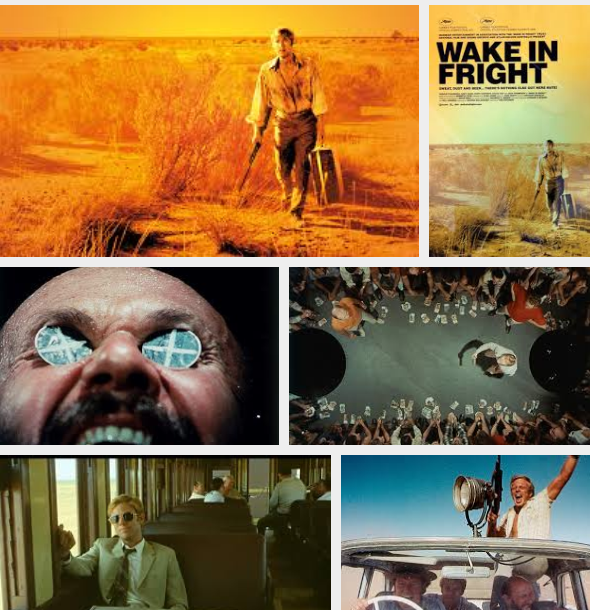
Wake in Fright is a local classic and has been released as a DVD, It still has an occasional screening at Movie Theatres, despite its age. When Wake in Fright was released in 1971, Australian audiences were appalled and the movie failed at the box office. The Cannes audience reaction however was that of awe.

The dark masterpiece was directed by Canadian born, Ted Kotcheff , it was the official Australian entry. The stark realism of the film takes the audience on a disturbing journey of moral decline in the Australian outback.

The realism of the movie is perpetuated through the use of locals rather than actors, no stunt men, dangerous driving, real two-up players and a documented kangaroo shoot. Australian audiences yelled out in the cinema,

“that’s not us.”

Kotcheff shot most of the outback sequences in Broken Hill where men outnumbered women 3 to 1 and the female suicide rate was 5 times the national average. The mateship culture that excluded women and bordered on homoerotic behaviour was present in Broken Hill just as it was portrayed at the Yabba.

An English born teacher, John Grant is lured into a journey to the heart of darkness. As in ‘Apocalypse Now’, the main character is corrupted and stripped of his dignity, as he travels deeper into the debauchery of his own soul. The brutality and larrikin nature of the characters destroys any notion of civilisation as they stumble precariously through a series of misadventures. The landscape, like the characters, is corrosive as the Director soaks each scene in hot colours reminiscent of rust. Sweat and dust texture each scene making the viewer feel hot and thirsty as the characters pour down endless quantities of beer. A feeling of claustrophobia and desperation resonates through out the movie as the landscape traps-in the men of Yabba. Beer is handed from bloke to bloke as a bridging ritual that bonds the man to the group.

Of the three women in the movie, the directors first wife Sylvia Kay is the main female character. Her role is at the fringe of the male cult.The mines of the outback remain a breeding ground for the supremacy of mateship.

The director Ted Kotcheff has made a series of successful movies including First Blood (also known as Rambo: First Blood), Orion, 1982 and Fun with Dick and Jane, Columbia, 1977. The director read the book written by Kenneth Cook (published 1961) and came to Australia to meet the locals. He was confounded by the Australian fight ritual between men and saw it as a desperate need to be touched. “All the little devils are proud of hell”, claims Doc.

The rough culture of this outback movie is able to breed unfettered by law or women. It is a place where sophistication and decency are wrung out in a wash of beer. Aussie audiences hated it. When Bill Collins showed it on Australian TV, he spruiked its merits but relented that he was expecting a lot of hate mail. The film has been released twice at the Cannes movie festival, which is a rare privilege and done only one other time in its history. The movie ran hot in France and stayed in theatres for up to 10 months even though it was in subtitles. According to the director, Martin Scorsese was a big fan.

What is it that the Australian audiences hate about this movie? Is it the actual deaths of kangaroos, the exclusion of women, the glorification of alcoholism, police corruption or the male rape? The French loved it but it’s not about them, it’s about us. The camera takes a deep and penetrating gaze into a bottomless pit of our nature and not a nonchalant glance. The characters in the movie are not Aussie caricatures but rather a raw portrayal of men behaving badly, the two up players are genuine players, real locals line the pubs, real shooters kill animals and the endless wasteland is also a member of the cast.

Wake in Fright was the last movie of Chips Rafferty and the first movie of Jack Thompson. Donald Pleasence’s portrayal of Doc is spellbinding in its sinister mischief-making. It’s been over 40 years since the movie was first released and it has stood the test of time. The movie remains relevant and continues to pickle our notions of ourselves.

The contemporary Australian family

Demographic information allows us to predict future trends so that town development, infrastructure and social needs are available for the next generation. It is also a fascinating peep behind the closed doors of our neighbourhood. Some of the results are surprising, for instance, if both of your parents are from an Anglo Australian background you are 80% more likely to marry into a different ethnic group.

imageAuthors of the text, Family Formation in 21st Century Australia, discuss changes that are taking place within the family format. They a Demographers and Sociologists attempting to interpret this complicated data through statistics. Ten Social Scientists explore separate themes and patterns that emerge from their research. The Editor Dr. Genevieve Heard and three of the authors Dr. Lindon Walker, Dr. Deb Demsey and Dr Kim Johnson talk to a small gathering of colleagues.

“This book tells the story of both continuity and change, it shows that Australians exercise considerable freedom of choice when it comes to forging pathways into creating families, but also that the tradition remains popular” Dr Heard claimed.

The traditional family has remained resilient in the first decade of the 21 Century, divorce rates have declined and many of these families are showing increased stability. Couples are more willing to marry than those of the previous Decade, however there are also the proliferations of new family styles. There is a rise in couples living together without formalising it through marriage. Latch relationships are also becoming more visible in the community; these are couples that live in separate households. These new types of families are co-existing with the traditional style however they are not replacing them. This mix within the community can offer a greater diversity.

IMG_1314

Dr Walkers field of study is inter-ethnic partnering, a study that continues to interest him as it crosses over multiple aspects that include religion, race and educational levels. The study required customised data and narrowing the field of research, as there are many difficulties, such as when are you considered Australian? Despite these complications some of the results are insightful and show that the longer an ethnic group resides in Australia the more likely they are to marry out of their community, as is the case with Italians and Greeks.

Europe 585

Indians and Iranians tend to marry within their own community but future generations may change this trend. Some cross partnering is one sided, such as Asian women and Australian men, the reverse is less popular. The majority of children that are born from two Australian parents will marry into another ethnic group.

Dr Demsey changes the theme as she discusses same-sex families; this group has been forced to win family rights and recognition through activism, firstly for marriage rights and then for children. Demanding access to fertility clinics has been marred by political intervention such as when former Prime Minister Mr Howard defined the family as being made up of a male and a female parent.

“Every Australian child has the right to a mother and a father” former Prime Minister John Howard claimed.

Dr Demsey explains that a lot has changed since 2001 as lesbians have won the right to use sperm banks (male couples often choose surrogacy). Amendments to laws have also enabled single sex couples to live together with legal protection over property issues.

Many same sex couples have to endure aggressive attitudes within the community that puts them under pressure and destabilises the couple. They might be less likely to endure. Friendships often provide the care and support often found in family life. Nuclear family’s are not the norm and couples often live in separate households that they share with housemates. Marriage type relationships that provide monogamy appeal more to younger Gays and less so, to mature couples.

Dr Demsey draws information from studies and surveys conducted by universities. Same sex couple numbers have been increasing however it is uncertain if it is becoming more popular or that people are more comfortable in declaring it. Children that live with male couples are 5%, whereas 20% of women couples have residential children. Ironically most homosexual couples have heterosexual children.

Dr Kim Johnson’s interest was in the family studies of our Aboriginal community. Couple relationships are more common with younger adults. Within these unions, more urban Aboriginals and those with higher educations will partner outside of their community whereas rural couples and those with less education will choose an Aboriginal partner.

IMG_6723

Aboriginal Australians have a higher fertility rate than non-Aboriginals, however it is comparable with other world communities such as what was common during the 1950’s baby boom. The most definitive distinction is that the women are more likely to start their families at a younger age, 40% are under 25. Younger parenting means that the parent is likely to be more energetic and have the support of younger grandparents that will also pass on cultural knowledge. The negative aspect of young parenting is that they might have less access to further education, employment and wealth.

The family network ideally provides a place for people to feel safe and loved, this is even more important when young children are brought into these relationships. The new family is born from a society that is re-inventing itself and exploring alternative options. It is interesting to look at the changes within ones own family, such as having children at a later age, as this is a modern invention.

Surviving Hitler

Rosa’s story

IMG_1469

Young Australian men joined forces and fought for Peace at a time when evil deeds were tools of power. War Stories surface from the battles and are told by the tired ones that survived. Both World Wars brought many refugees who fled Europe to build a life for future generations in Australia.

Rosa was born in Poland, she was 13 years of age when World War 2, broke out on September 1939. Her young life would be thrown into a horror that she would have to endure. What is most remarkable about Rosa’s account of what happened to her and her family was her unrelenting bravery.

Her father had a shop that sold leather goods such as purses, shoes and bags; it was a successful business that provided a comfortable life for Rosa and her family. The war encroached upon them bit by bit, schools were closed and then the shops were off limits to them because they were Jewish. They had to leave their home, possessions and business and move into a ghetto.

Rosa’s 17-year-old sister decided to go to Russia where she could continue her studies in design, or find work. Many Jewish people thought they would be safer in Russia. Meanwhile Rosa’s remaining family that included an older brother and a baby were resettled on a cold and raining day. In the morning was a ‘Selection’.

“We were lucky as we were all selected to go on one side, I don’t know which one was the good one, right or left? But we were allowed to go home. That day I lost my grandparents, aunties and uncles.” Rosa explains.

Many of Rosa’s extended family were sent to the death camps in the town of Auschwitz, they were ignorant of their fate and thought that the re-location was into the township. Life was very dangerous. A near by Synagogue was burnt with men within it and Rosa remembered the dreadful smell.

Her older brother was sent to a work camp. One day he came home with a self- inflicted wound, a friend at the camp had advised him to cut himself so that he could get some leave. It worked but overnight the wound got infected. It was curfew but the mother risked going out and pleaded with a German soldier to send for a doctor. His life was saved as the doctor came and gave him the medication he needed to recover.

Food was scarce and Rosa stood in bread lines from 5am in the morning, but it made no difference as she was denied her share, due to her ethnic background. Her father resorted to the Black Market. Most things were available on the Black Market so her father decided to sell his leather goods on it, to generate an income.

A Jewish man in their neighbourhood was collaborating with the Germans and he found out about the side business. Every Thursday Germans would search Rosa’s home and even though they could not find any evidence they arrested her father. Rosa’s mother paid a ransom to the traitor every week to free her husband and keep him out of jail.

The family were sent orders that Rosa was to go to a work camp even though she was very young and weak. Originally, they hid her at an Aunties’ house but she was discovered and reissued orders. Despite her family’s protests, Rosa decided to go so as to protect them from repercussions. Her father thought that if she were wounded, as her brother had been, she would be able to stay with them. He was wrong. He burnt his daughters arm with acid and that action diverted her from being sent to the work farm but put her in line for Auschwitz

The ‘traitor’ that had been collecting money from Rosa’s family saw that she was on the list to the death camp. He decided to help her due to the payments he had received.

“He could say who was going to live and who was going to die”. Rosa explains.

“Your too young to die” The Traitor told her.

She was saved from the death camp and ended up at a work camp where she was told that she would be making parts for bicycles. She was then told to give up all of her meagre possessions such as watches, photos and jewellery. As her greatest possession were two photographs (that she still has) she hid them behind a brick in the wall. They no longer called her by name but rather by a number, which she resented.

When she was working at the factory she went into a back office looking for an officer. She went into the vacated room and read the German signage on the wall and realised that they weren’t making bicycles. They were making bombs.

“’My God! What are you doing Rosa? Helping to kill your family, your friends? ”

No! I wont do it. Rosa explained her thoughts.

When she was discovered in the forbidden office, she pretended that she couldn’t read German. Secretly she asked God to forgive her lie. When she was returned to the factory she informed her friend of her discovery.

“I’m going to sabotage the bombs” young Rosa declared

“ I made them not to measurement, I made them bigger, they were good for nothing. My boss, he noticed and asked me to concentrate more, he was German so I couldn’t tell him. I broke the needles, I made them bigger and everyday he said, what you are doing is wrong. One day more men came and stood behind my back and watched me working. I break more needles; I make them bigger. They told me to stand up and sent me to a German woman, she was not very nice and she told me that I was to go to Auschwitz.”   Rosa recalled.

That was three months before the war had ended. Everyday Rosa reported to her and everyday she was told that she would go the following day. They couldn’t send her because the Liberation had begun; it was 1945. Suddenly there was no work for the girls and the factory seized operations. Men with guns surrounded the camp and called for the girls to come out but they were too frightened to do so. They yelled out to them that they were free but Rosa and her friends didn’t believe them until from a window, she saw her cousin in the crowd.

“Its not a joke anymore, we are free’ Rosa declared to the girls.

“We laughed, we cried, we kissed. The first thing I did was go a get the pictures,” Rosa explained.

Rosa came to Australia in 1960 with her husband and two children. They settled and made a new home. She is happy here and thinks that it is a beautiful country.

“ I have seven great grandsons. Hitler didn’t survive long enough to kill me too.” Rosa states.

Her final message to the next generation is that ‘we are all the same’ and not to discriminate!’

* Rosa spoke at the Jewish Holocaust Museum, Elsternwick

(Rosa’s older brother and sister survived but her parents and baby sister did not).


Mick Doleman; Survivor & Protector

Men United to protect women

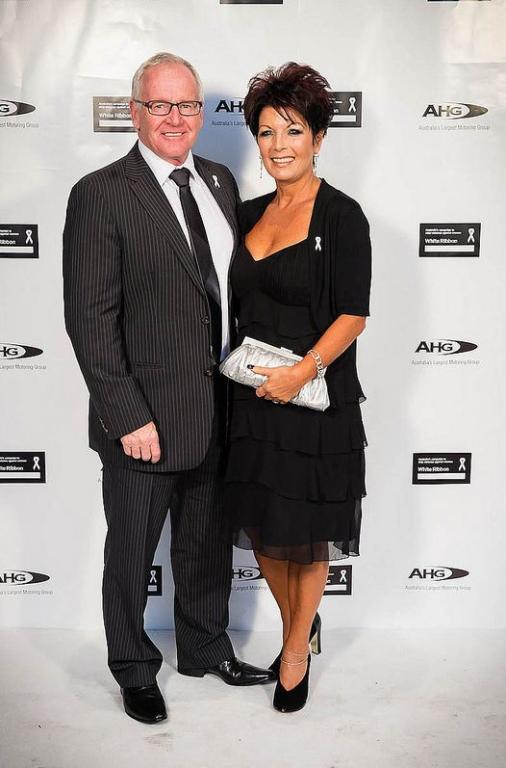
 IMG_1237One woman is murdered, every week in Australia by her spouse. It’s an alarming statistic. The White Ribbon campaign is designed to inform the nation of this serious dilemma. This is a national, male led campaign to end violence against women. Globally, White Ribbon is active in more than sixty countries.

White Ribbon Ambassadors advocate themselves to protect women. They come from all walks of life and include former Prime Minister Kevin Rudd. Within our community men are adding their names to the growing list.

Mick Doleman, Deputy National Secretary of the Maritime Unions, for 43 years, spoke to Melbourne Press in regard to his commitment to this cause.

Mike attributes his moral compass to the early influences of his life. He came from a strong family. At 15, he became a sailor and mixed with a breed of men that he deeply respected. He emulated himself on these early role models. The men were smart in worldly affairs and possessed a great respect for women, aboriginals and other nationalities. They spoke up against racism.

In 1978, Mike was aboard the Blythe Star when it sank, off the east coast of Tasmania. He was 18 years old and spent 11 days with ten men, on a life boat where three died before they were rescued.

“What doesn’t kill you makes you stronger” he claims.

In 1984 he became the Assistant Branch Secretary of the Seamen’s Union of Australia. He was the first person in the Maritime Industry to establish a sexual harassment policy. He has been honored as the White Ribbon Ambassador of the year, for two years.

“Government’s have to put massive resources in place and police need to be trained in how to deal with domestic issues” Mr Doleman states.

Many children are traumatized by domestic violence. By recognizing the seriousness of abusive relationships, lives can be saved through intervention. Through the White Ribbon campaign, men have become united to protect women.

(Artwork ; The Great Leviathon  TJ B-Webb )